

[2025] Use Valid P-SAPEA-2023 Exam - Actual Exam Question & Answer
Test Engine to Practice P-SAPEA-2023 Test Questions
NEW QUESTION # 13
What are important factors of the SAP BTP. Cloud Foundry environment during runtime that you need to consider?
- A. Number of users and API calls
- B. Programming language and buildpacks
- C. CPU capacity and memory size of the application
Answer: B
Explanation:
In the SAP BTP Cloud Foundry environment, several factors are critical during runtime to ensure optimal application performance and scalability. The correct answer, A, highlights two fundamental aspects:
Programming language: This determines the specific buildpack to be used, as Cloud Foundry supports multiple programming languages through different buildpacks which provide framework and runtime support for applications.
Buildpacks: These are key components in the Cloud Foundry architecture that provide runtime and framework support necessary to build and deploy applications in various programming languages effectively.
These elements are crucial as they directly impact how applications are built, deployed, and run within the Cloud Foundry environment, influencing performance, compatibility, and scalability.
:
SAP BTP Cloud Foundry documentation.
Buildpacks and programming language support in SAP BTP.
NEW QUESTION # 14
Select the most appropriate sequence of critical Business Capabilities for the Business Architecture Roadmap.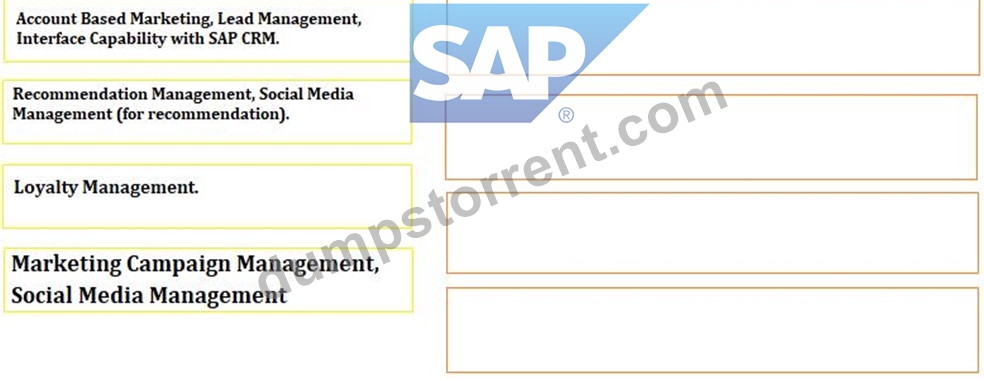
Answer:
Explanation: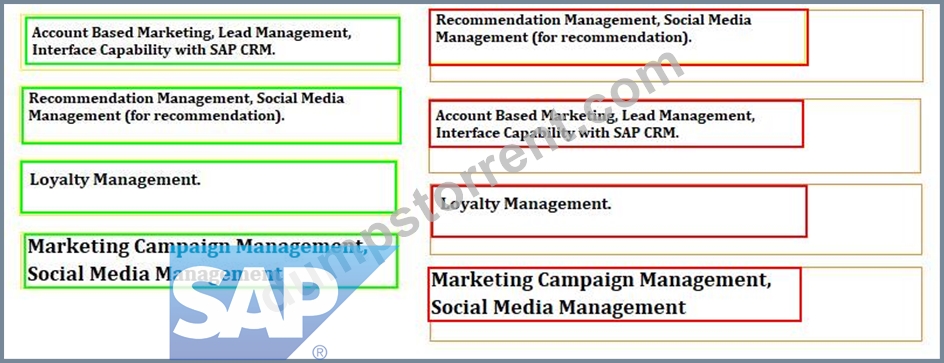
NEW QUESTION # 15
For the next Architecture Board meeting, you need to determine the next steps required after the business, application/data and technology architecture designs have been created. What do you recommend?
- A. Finalizing the Business, Application/Data, and Technology Architecture artifacts. Building an Architecture Roadmap. Creating a first draft of the Project/Rollout Project plan.
- B. Establishing change management processes for the management of the business application/data and technology artifacts Handing over the artifacts to the implementation partner and rolling out the project
- C. Reviewing Business Application/Data and Technology Architecture artifacts with stakeholders and signing off on first versions.Using Transition Architectures to build the Architecture Roadmap. Creating first drafts of the required work packages and the Project/Rollout plan.
Answer: C
Explanation:
Explanation
According to the SAP Enterprise Architect framework, which is based on the TOGAF ADM, the next steps are:
Reviewing Business, Application/Data, and Technology Architecture artifacts with stakeholders and signing off on first versions. This step involves validating and verifying the architecture designs with the relevant stakeholders, such as business owners, users, developers, and vendors. The goal is to ensure that the architecture designs meet the requirements and expectations of the project, and to obtain formal approval for the first versions of the artifacts.
Using Transition Architectures to build the Architecture Roadmap. This step involves defining and prioritizing the Transition Architectures, which are intermediate states between the Baseline Architecture (the current situation) and the Target Architecture (the desired future state). The Transition Architectures describe how to move from one state to another in a feasible and manageable way, taking into account the constraints and dependencies of the project. The Architecture Roadmap is a document that outlines the sequence and timing of the Transition Architectures, as well as the deliverables, resources, and risks associated with each one.
Creating first drafts of the required work packages and the Project/Rollout plan. This step involves identifying and defining the work packages, which are units of work that can be assigned to a project team or a vendor for implementation. The work packages specify the scope, objectives, dependencies, assumptions, and acceptance criteria of each unit of work. The Project/Rollout plan is a document that describes how to execute and monitor the work packages, as well as how to manage the change management, quality assurance, and governance aspects of the project.
The other options (B and C) are not correct for the next steps required after the architecture designs have been created, because they either skip or misrepresent some of the steps in the SAP Enterprise Architect framework.
For example:
Option B is not correct because it does not include reviewing and signing off on the first versions of the architecture artifacts with stakeholders, which is an important step to ensure alignment and agreement on the architecture designs. It also does not mention using Transition Architectures to build the Architecture Roadmap, which is a key step to define and prioritize the intermediate states between the Baseline and Target Architectures.
Option C is not correct because it does not follow the SAP Enterprise Architect framework at all. It suggests establishing change management processes for the management of the architecture artifacts, which is something that should be done earlier in the framework, not after creating the architecture designs. It also suggests handing over the artifacts to the implementation partner and rolling out the project, which is a premature and risky move that does not take into account the need for defining Transition Architectures, work packages, and Project/Rollout plan.
For more information on the SAP Enterprise Architect framework and its phases, you can refer to SAP Enterprise Architect | SAP Learning or SAP Certified Professional - SAP Enterprise Architect.
NEW QUESTION # 16
In the SAP Enterprise Architecture Framework, which of the following artifacts are part of the opportunities & solution phase? Note: There are 3 correct answers to this question.
- A. Application Architecture Roadmap
- B. Migration plan
- C. Business Architecture Roadmap
- D. Implementation Roadmap
- E. Work Breakdown structure
Answer: B,C,D
Explanation:
Explanation
The Opportunities & Solutions phase of the SAP Enterprise Architecture Framework (EAF) is concerned with defining the target architecture and developing a roadmap for implementation. The following artifacts are typically produced in this phase:
Business Architecture Roadmap: This artifact describes the sequence of activities and deliverables required to achieve the target business architecture.
Implementation Roadmap: This artifact describes the sequence of activities and deliverables required to implement the target solution architecture.
Migration Plan: This artifact describes the steps involved in migrating from the current architecture to the target architecture.
The Work Breakdown Structure and the Application Architecture Roadmap are typically produced in the subsequent phases of the EAF, namely the Implementation and Migration phases.
Here is a table that summarizes the different artifacts and the phases in which they are typically produced: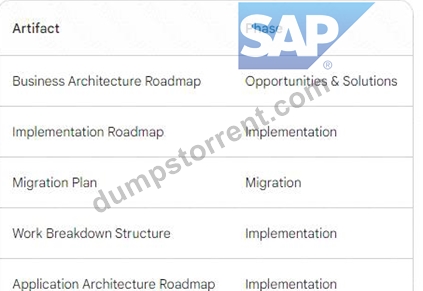
NEW QUESTION # 17
As the Chief Enterprise Architect of your company you have been asked by the CIO to apply agile principles instead of following the sequential phases of TOGAFS ADM. How do you respond?
- A. It is essential to fully understand the business needs and to successfully review the business architecture with critical stakeholders before going to the next phase. In the implementation phase, agile approaches can naturally provide quick wins, constant progress, and the benefit of early validation. The phased approach, during architecture definition phases, avoids double work and will lead to overall better results.
- B. The TOGAF ADM already embraces agile principles within and across phases and generally follows a cyclic approach. The SAP EA Framework builds on that and is especially suitable for organizations that follow agile principles.
- C. It is reasonable to apply an agile methodology for the most urgent tasks and switch to the process as guided by the SAP EA Framework later, as long as the fundamental IT architecture is not affected Collecting "low-hanging fruit, and realizing instant value before using the SAP EA Framework, and ensuring an overall successful transformation is possible.
- D. The SAP EA Framework combines the sequential approach of the TOGAF ADM with agile principles Agile principles are included and can be applied only to Application Architecture. Therefore, the SAP EA Framework is especially suitable for organizations that follow agile principles.
Answer: B
Explanation:
In the context of incorporating agile principles into the TOGAF's Architecture Development Method (ADM), Option D is accurate. The TOGAF ADM is inherently iterative and dynamic, which means that it doesn't strictly have to be a linear process. It allows for feedback at any stage of the development cycle and can be adapted to include agile practices. The SAP Enterprise Architecture (EA) Framework is built to be flexible and can incorporate agile principles, supporting rapid iterations and adaptive planning. The agile approach is integrated into the SAP EA Framework to enhance responsiveness and to enable a continuous delivery model that aligns with the iterative nature of the ADM. Agile principles can be applied within and across the different phases of the ADM, promoting a more flexible and responsive architecture development process that is suited for organizations following agile methodologies.
Reference:
TOGAF documentation outlining the iterative nature of ADM.
SAP EA Framework documentation discussing integration with agile methodologies.
NEW QUESTION # 18
What kind of applications can you develop with SAP Business Application Studio?
- A. ABAP applications
- B. SAPUI5 (SAP Fiori) applications
- C. SAPUI5 (SAP Fiori) applications and ABAP applications
Answer: B
Explanation:
SAP Business Application Studio is a modern development environment designed to support the development of various SAP-centric applications. Among the supported application types are:
SAPUI5 (SAP Fiori) applications (C): SAP Business Application Studio provides extensive tools and templates specifically tailored for developing SAPUI5 applications, which are the backbone of the SAP Fiori user experience. This includes support for frontend development with rich user interfaces, integration with SAP services, and adherence to SAP Fiori design principles.
Options A and B are incorrect because SAP Business Application Studio does not support ABAP development directly within its environment. ABAP development traditionally requires a different set of tools and environments provided by SAP, such as the ABAP Development Tools (ADT) in Eclipse or the ABAP environment on SAP Cloud Platform.
:
SAP Business Application Studio documentation.
SAP Fiori development guidelines provided by SAP.
NEW QUESTION # 19
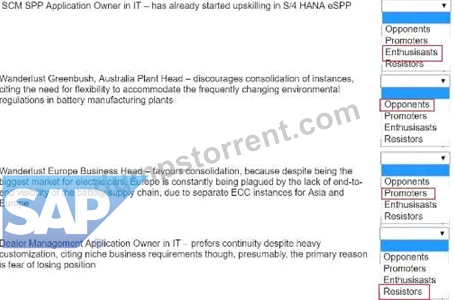
While trying to identify and map key stakeholders in Wanderlust, you, as the Chief Enterprise Architect, have been evangelizing the strategic business and IT objectives with business and IT departments across regions and taking in their views on the upcoming business transformation, Match the feedback from stakeholders (shown on the left) to the categorization and to some of the actions in the dropdown lists.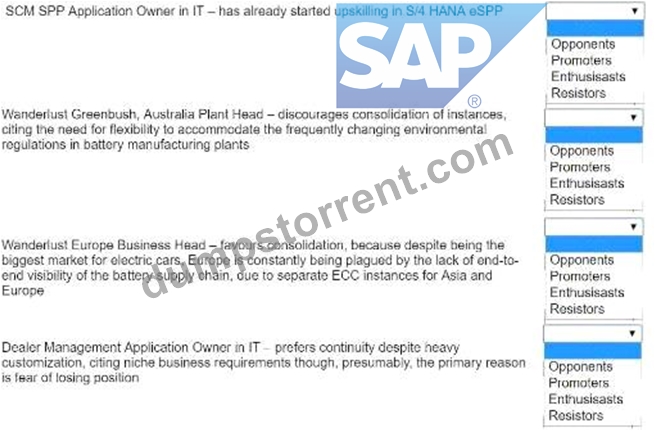
Answer:
Explanation: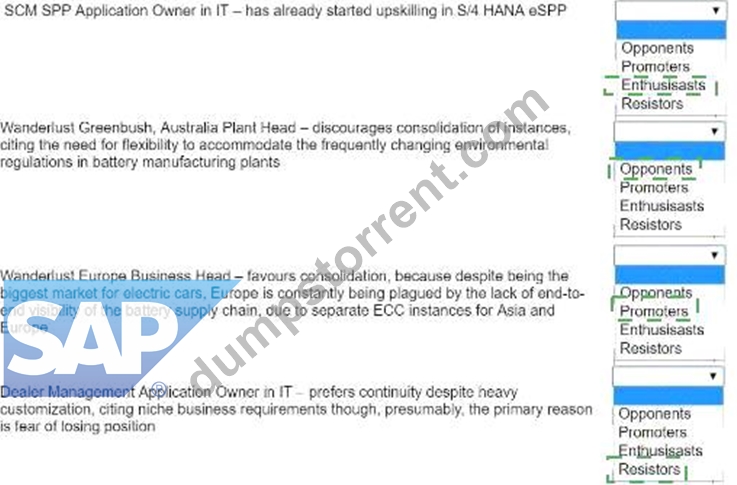
NEW QUESTION # 20
As a result of solution mapping, business capabilities might require services which partners have implemented in SAP BTP. Which SAP components and services, if any, are required to integrate such BTP partner services with an on-premise SAP S/4HANA system (hybrid scenario)?
- A. No other components are required to make an SAP on-premise backend system securely accessible over SAP BTP SAP BTP automatically establishes secure connections in SAP backend systems.
- B. SAP Cloud Connector to make the on-premises system available to applications and services in a given SAP BTP sub account. Preferably use the SAP BTP Destination Service in combination with Cloud Connector.
- C. SAP HANA Cloud Connection, and the corresponding SAP Data Provisioning Agent, to make the on-premises system available to applications and services in a given SAP BTP sub account. Preferably use the SAP BTP Destination Service.
Answer: B
Explanation:
In a hybrid scenario, where business capabilities require services which partners have implemented in SAP BTP and an on-premise SAP S/4HANA system, the following SAP components and services are required to integrate such BTP partner services with the on-premise system:
SAP Cloud Connector: The SAP Cloud Connector is a software component that allows you to connect your on-premise SAP systems to SAP BTP. The Cloud Connector provides a secure connection between your on-premise system and SAP BTP, and it also makes your on-premise system available to applications and services in SAP BTP.
SAP BTP Destination Service: The SAP BTP Destination Service is a service that provides a single point of entry for accessing on-premise systems from SAP BTP. The Destination Service makes it easy to manage and secure connections to on-premise systems, and it also provides a way to federate data from different on-premise systems.
In order to integrate BTP partner services with an on-premise SAP S/4HANA system, you will need to install the SAP Cloud Connector on your on-premise system and register the Cloud Connector with SAP BTP. You will also need to create a destination in the SAP BTP Destination Service for your on-premise system. Once you have done this, you will be able to access the on-premise system from applications and services in SAP BTP.
It is important to note that you can also use other SAP components to integrate on-premise systems with SAP BTP. However, the SAP Cloud Connector and the SAP BTP Destination Service are the most commonly used components for this purpose.
To integrate BTP partner services with an on-premise SAP S/4HANA system, you need to use the SAP Cloud Connector, which is a reverse proxy that establishes a secure connection between your on-premise system and your SAP BTP subaccount5. The Cloud Connector acts as a bridge between your on-premise network and a trusted subaccount on SAP BTP6. It allows you to access resources in your on-premise network from applications running on SAP BTP without exposing your internal landscape to the internet7.
To simplify the configuration and consumption of the Cloud Connector connection, you can use the SAP BTP Destination Service, which is a service that allows you to define and manage destinations for accessing remote systems from applications running on SAP BTP8. A destination is a set of properties that contains information such as the URL, authentication method, proxy type, and additional parameters of a remote system9. By using the Destination Service, you can centrally manage and securely store the connection details of your on-premise system and consume them from your BTP partner services.
Verified Reference: 5: https://help.sap.com/viewer/cca91383641e40ffbe03bdc78f00f681/Cloud/en-US/e6c7616abb5710148cfcf3e75d96d596.html | 6: https://help.sap.com/viewer/cca91383641e40ffbe03bdc78f00f681/Cloud/en-US/8d3b28a7c1644a1c9d1ee165ec0a8cf4.html | 7: https://help.sap.com/viewer/cca91383641e40ffbe03bdc78f00f681/Cloud/en-US/e54cc8fbbb571014a4d9e7f02f9fa8e4.html | 8: https://help.sap.com/viewer/cca91383641e40ffbe03bdc78f00f681/Cloud/en-US/3cb7b81115c44cf594e0e3631291af94.html | 9: https://help.sap.com/viewer/cca91383641e40ffbe03bdc78f00f681/Cloud/en-US/e54f70d327154aa0a4ba36ce7ac49c83.html
NEW QUESTION # 21
Green Elk & Company is the world's leading manufacturer of agricultural and forestry machinery. The former company slogan "Elk always runs has recently been changed to "Elk feeds the world" One of Green Elk's strategic goals is to increase its revenue in the emerging markets of China, India, and other parts of Asia by 80 % within three years. This requires a new business model that caters to significantly smaller farms with limited budgets. You are the Chief Enterprise Architect and the CIO asked you to conduct interviews with the key stakeholders of Green Elk to assess the business strategy. You are planning to interview the owner of the business unit of finished goods. Which of the following sets of questions would you ask?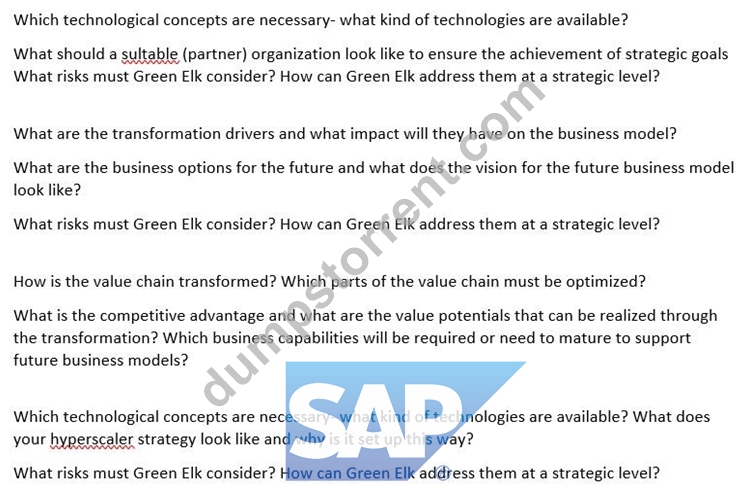
- A. Which technological concepts are necessary- what kind of technologies are available? What does your hyperscaler strategy look like and why is it set up this way? What risks must Green Elk consider? How can Green Elk address them at a strategic level?
- B. Which technological concepts are necessary- what kind of technologies are available? What should a sultable (partner) organization look like to ensure the achievement of strategic goals What risks must Green Elk consider? How can Green Elk address them at a strategic level?
- C. How is the value chain transformed? Which parts of the value chain must be optimized?What is the competitive advantage and what are the value potentials that can be realized through the transformation? Which business capabilities will be required or need to mature to support future business models?
- D. What are the transformation drivers and what impact will they have on the business model?What are the business options for the future and what does the vision for the future business model look like?What risks must Green Elk consider? How can Green Elk address them at a strategic level?
Answer: C
Explanation:
In the context of Green Elk & Company's strategic goal to expand in emerging markets, the most pertinent set of questions to ask the owner of the business unit of finished goods would focus on the transformation of the value chain and the competitive advantages that can be leveraged. Therefore, the best set of questions is represented by option C:
How is the value chain transformed? This question aims to understand the changes required in the current value chain to support the new business model targeting smaller farms with limited budgets. It's essential to identify which processes and interactions need to be adapted or redefined to meet the needs of the emerging markets.
Which parts of the value chain must be optimized? Optimization efforts should be directed towards the most impactful areas of the value chain that can drive efficiency, reduce costs, and improve service delivery in the context of the new markets.
What is the competitive advantage and what are the value potentials that can be realized through the transformation? Understanding the unique strengths of Green Elk & Company and how they can be harnessed to create value in the new business environment is crucial for the success of the expansion strategy.
Which business capabilities will be required or need to mature to support future business models? The company must assess its current capabilities and determine which ones need to be developed or enhanced to support the strategic goals effectively.
These questions are designed to elicit information that will help in crafting a business strategy that is aligned with the company's vision of feeding the world and achieving significant revenue growth in the targeted emerging markets.
Reference:
SAP. (n.d.). SAP Enterprise Architecture Framework. SAP Community.
The Open Group. (2018). TOGAF Version 9.2: Enterprise Architecture Framework.
Porter, M.E. (1985). Competitive Advantage: Creating and Sustaining Superior Performance. Free Press.
NEW QUESTION # 22
You design a Solution Architecture, based on SAP S/4HANA, for an internationally active customer that has a national subsidiary in China and other countries that have special requirements for data storage. As the responsible Enterprise Architect, your task is to propose a solution that takes these special requirements into account. How do you proceed when your customer's Architecture Guideline calls for following a "cloud-first" approach?
- A. This depends on the required solution components. None of the selected SAP solutions may support the regulated environment, so alternative solutions or custom developed solutions should be considered.
- B. This depends on the required solution components. Public cloud solutions may not meet the necessary data protection requirements. Therefore, private cloud or on-premise options must be considered when developing the solution landscape.
- C. This is independent of the solution components required, because SAP S/4HANA Cloud and all SAP SaaS solutions meet all applicable data protection requirements, Private cloud or on-premises options therefore do not need to be considered. The "cloud-first" approach can be fully implemented.
Answer: B
Explanation:
Explanation
The customer's architecture guideline calls for following a "cloud-first" approach, but this does not mean that all solutions must be deployed in the cloud. In some cases, private cloud or on-premise options may be necessary to meet the customer's data protection requirements.
For example, if the customer's subsidiary in China requires that data be stored within China, then a private cloud solution in China may be the best option. Similarly, if the customer's other subsidiaries have different data protection requirements, then a hybrid solution that combines cloud and on-premise deployments may be necessary.
The Enterprise Architect must carefully consider the customer's specific requirements and constraints before making a decision about the deployment environment.
Here are some of the factors that the Enterprise Architect should consider:
The customer's data protection requirements: The Enterprise Architect must understand the customer's specific data protection requirements and ensure that any solution meets those requirements.
The availability of cloud-based solutions that meet the customer's requirements: Not all cloud-based solutions meet the same data protection requirements. The Enterprise Architect must ensure that the cloud-based solutions that are being considered meet the customer's requirements.
The cost of different deployment options: The Enterprise Architect must consider the cost of different deployment options, including cloud, private cloud, and on-premise.
The scalability and performance requirements of the solution: The Enterprise Architect must ensure that the solution meets the customer's scalability and performance requirements, regardless of the deployment environment.
By carefully considering all of these factors, the Enterprise Architect can make a decision about the deployment environment that meets the customer's specific requirements and constraints.
NEW QUESTION # 23
Which integration styles does SAP s Integration Advisory Methodology (ISA-M) cover in general?
- A. Cloud2Cloud/Cloud2OnPremise/Cloud2Cloud/User2On Premise/User2Cloud/Thing2On Premise/Thing2Cloud
- B. Ul Integration/Process Integration/Data Integration/Thing Integration.
- C. Process Integration/Data Integration/Analytics Integration/User Integration/Thing Integration.
Answer: C
Explanation:
Explanation
The Integration Advisory Methodology (ISA-M) is a framework that helps organizations to design, build, and manage their integration landscape. ISA-M covers a wide range of integration styles, including:
Process Integration: This style of integration involves the integration of business processes across different systems and applications.
Data Integration: This style of integration involves the integration of data from different sources into a single data repository.
Analytics Integration: This style of integration involves the integration of data from different sources for the purpose of analytics.
User Integration: This style of integration involves the integration of user interfaces from different systems and applications.
Thing Integration: This style of integration involves the integration of things, such as sensors and actuators, with other systems and applications.
ISA-M also includes a number of other integration styles, such as event-driven integration, service-oriented integration, and enterprise application integration.
By covering a wide range of integration styles, ISA-M provides organizations with a flexible framework that can be used to meet their specific integration needs.
SAP's Integration Solution Advisory Methodology (ISA-M) is a framework that helps enterprise architects to define and execute an integration strategy for their organization. ISA-M covers five integration styles that represent different aspects of integration in a hybrid landscape. These integration styles are3:
Process Integration: This integration style enables end-to-end business processes across different applications and systems, such as SAP S/4HANA, SAP SuccessFactors, or third-party solutions. Process integration typically involves orchestrating or choreographing multiple services or APIs to achieve a business outcome.
Data Integration: This integration style enables data exchange and synchronization between different data sources and targets, such as SAP HANA, SAP Data Warehouse Cloud, or third-party databases. Data integration typically involves extracting, transforming, and loading (ETL) data to support analytical or operational scenarios.
Analytics Integration: This integration style enables data visualization and exploration across different data sources and targets, such as SAP Analytics Cloud, SAP BusinessObjects BI Platform, or third-party tools.
Analytics integration typically involves creating dashboards, reports, or stories to provide insights and recommendations for decision making.
User Integration: This integration style enables user interaction and collaboration across different applications and systems, such as SAP Fiori Launchpad, SAP Jam, or third-party portals. User integration typically involves creating consistent and seamless user experiences that integrate multiple UI technologies and frameworks.
Thing Integration: This integration style enables device connectivity and management across different applications and systems, such as SAP IoT, SAP Edge Services, or third-party platforms. Thing integration typically involves connecting physical devices or sensors to the cloud or the edge and enabling data ingestion, processing, and action.
Verified References: 3:
https://help.sap.com/docs/btp/architecture-and-development-guide-for-industry-cloud-solutions/runtimes-environ
NEW QUESTION # 24
For the next Architecture Board meeting, you need to determine the next steps required after the business, application/data and technology architecture designs have been created. What do you recommend?
- A. Finalizing the Business, Application/Data, and Technology Architecture artifacts. Building an Architecture Roadmap. Creating a first draft of the Project/Rollout Project plan.
- B. Establishing change management processes for the management of the business application/data and technology artifacts Handing over the artifacts to the implementation partner and rolling out the project
- C. Reviewing Business Application/Data and Technology Architecture artifacts with stakeholders and signing off on first versions.Using Transition Architectures to build the Architecture Roadmap. Creating first drafts of the required work packages and the Project/Rollout plan.
Answer: C
Explanation:
After the business, application/data, and technology architecture designs have been created, it is vital to engage with stakeholders to review these artifacts and gain their sign-off, ensuring that the designs meet the business requirements and are aligned with the strategic direction of the company. Transition Architectures are an essential part of building the Architecture Roadmap as they provide interim 'target states' that enable the organization to move towards the final architecture in a controlled manner. Creating the initial drafts of the work packages and the project/rollout plan is necessary to commence the detailed planning for implementation.
Reference = This approach is documented within the SAP Enterprise Architecture development process, which underscores the importance of stakeholder engagement, Transition Architectures, and detailed planning for successful EA implementation. Relevant documents include "SAP Enterprise Architecture Framework" and "Transition Architecture Planning in SAP Environments."
NEW QUESTION # 25
The CIO of Wanderlust strongly feels that the seldom-used legacy Marketing application cannot be the platform to rejuvenate their online marketing business. As Chief Enterprise Architect, the CIO has entrusted you with the responsibility of finding a suitable replacement that can support all current processes and also address the issues plaguing the existing application. Which of the following should you do to conclusively shortlist possible applications to replace the existing one? Note: There are 2 correct answers to this question.
- A. Adopt a process centric approach, relate Wanderlust processes to industry standard processes, and identify applications/ solutions which deliver such processes.
- B. Understand the features of leading online marketing applications available in the market through product demonstrations and rank the applications in terms of features.
- C. Start with current processes, map business capabilities to these processes, and identify which application(s) in the market can deliver such capabilities.
- D. Compare the costs of those market leading online marketing applications and rank the top applications in terms of license, implementation, maintenance and subscription cost.
Answer: A,C
Explanation:
Explanation
Starting with the current processes will help to understand the capabilities that are needed in a new application.
This will help to narrow down the field of potential applications and identify those that are most likely to meet the needs of Wanderlust.
Mapping business capabilities to these processes will help to identify the gaps in the current capabilities and the areas where improvement is needed. This will help to ensure that the new application meets the needs of Wanderlust and addresses the issues plaguing the existing application.
Relating Wanderlust processes to industry standard processes will help to identify applications that are already being used by other organizations. This can be a good way to ensure that the new application is compatible with other systems and that it can be easily integrated with existing systems.
The other two options, Comparing the costs of those market leading online marketing applications and Understanding the features of leading online marketing applications available in the market through product demonstrations and ranking the applications in terms of features, are not as critical at this stage. The costs of the applications can be compared once the shortlist of applications has been finalized. The features of the applications can be understood through product demonstrations once the shortlist has been finalized.
Therefore, the best course of action is to start with the current processes, map business capabilities to these processes, and identify which application(s) in the market can deliver such capabilities. This will help to narrow down the field of potential applications and identify those that are most likely to meet the needs of Wanderlust.
Here are some of the benefits of taking a process-centric approach to selecting a new marketing application:
It can help to ensure that the new application meets the needs of the business.
It can help to identify applications that are already being used by other organizations.
It can help to ensure that the new application is compatible with other systems and that it can be easily integrated with existing systems.
NEW QUESTION # 26
Green Elk & Company is the world's leading manufacturer of agricultural and forestry machinery. The former company slogan "Elk always runs has recently been changed to "Elk feeds the world". One of Green Elk's strategic goals is to increase its revenue in the emerging markets of China, India, and other parts of Asia by 80% within three years. This requires a new business model that caters to significantly smaller farms with limited budgets. The CIO asks you, the Chief Enterprise Architect, to present an Architecture Roadmap that addresses the business challenge. According to the SAP Enterprise Architecture Framework, what is the best answer?
- A. Reuse the artifacts of previous phases as input for creating roadmaps. Focus on the Target Architecture and define an application architecture roadmap.
- B. Reuse the artifacts of previous phases as input for creating roadmaps. Start with a roadmap construction table, by defining initiatives and business outcomes, and detailing the business capabilities and solutions, to create two versions of a roadmap (outcome-based and application-specific)
- C. Create a work breakdown structure to identify milestones, key deliverables and resources to outline the planned transformation.
- D. Reuse the artifacts of previous phases as input for creating roadmaps. Focus on the Business Strategy Map with business capabilities and initiatives and define a business architecture roadmap
Answer: B
Explanation:
Explanation
The SAP Enterprise Architecture Framework (EAF) defines an Architecture Roadmap as a "high-level plan that describes the sequence of activities and deliverables required to achieve the target architecture." The roadmap should be based on the artifacts of the previous phases of the EAF, such as the Business Strategy Map, the Solution Concept, and the Baseline Business and Solution Architecture.
The first step in creating an Architecture Roadmap is to define the initiatives that will be needed to achieve the target architecture. These initiatives should be aligned with the business outcomes that the organization is trying to achieve.
The next step is to detail the business capabilities and solutions that will be needed to support the initiatives.
This will help to ensure that the roadmap is realistic and achievable.
Finally, the roadmap should be created in two versions: an outcome-based roadmap and an application-specific roadmap. The outcome-based roadmap will show how the initiatives will achieve the business outcomes. The application-specific roadmap will show how the solutions will be implemented.
By following these steps, you can create an Architecture Roadmap that will help you to achieve your organization's strategic goals.
Here are some of the benefits of creating an Architecture Roadmap:
It can help you to visualize the sequence of activities and deliverables required to achieve your goals.
It can help you to identify dependencies between activities and deliverables.
It can help you to track progress and to make adjustments as needed.
It can help you to communicate your plans to stakeholders.
Therefore, an Architecture Roadmap can be a valuable tool for managing complex transformations.
According to the SAP Enterprise Architecture Framework, which is a methodology and toolset by the German multinational software company SAP that helps enterprise architects define and implement an architecture strategy for their organizations, the steps involved in creating an Architecture Roadmap are:
Reuse the artifacts of previous phases as input for creating roadmaps. The previous phases of the architecture development cycle are: architecture vision, business architecture, information systems architecture, and technology architecture. The artifacts of these phases provide the information and guidance for defining the scope, objectives, stakeholders, requirements, constraints, and solutions of the architecture project. Some of the artifacts that can be reused for creating roadmaps are: stakeholder map, business strategy map, solution strategy, solution context diagram, solution component diagram, solution application use-case diagram, solution value flow diagram, etc.
Start with a roadmap construction table, by defining initiatives and business outcomes, and detailing the business capabilities and solutions. A roadmap construction table is a tool that helps to structure and organize the information and elements that are needed to create a roadmap. It consists of four columns:
initiatives, business outcomes, business capabilities, and solutions. Initiatives are the strategic actions or projects that are planned to achieve the business goals and drivers. Business outcomes are the measurable results or benefits that are expected from implementing the initiatives. Business capabilities are the skills, resources, and competencies that are required or need to mature to support the initiatives and outcomes. Solutions are the products or services that are used or delivered to enable the capabilities and outcomes.
Create two versions of a roadmap (outcome-based and application-specific). A roadmap is a visual representation of the transition architectures that will move the organization from its current state (baseline architecture) to its desired future state (target architecture). A roadmap shows the sequence and timing of the transition architectures, as well as the deliverables, resources, and risks associated with each transition architecture. There are two types of roadmaps that can be created: outcome-based and application-specific. An outcome-based roadmap focuses on the business outcomes that are achieved by implementing the transition architectures. An application-specific roadmap focuses on the solutions or applications that are implemented or changed by the transition architectures.
The other options (A, B, C) are not correct for how to present an Architecture Roadmap that addresses the business challenge because they either skip or misrepresent some of the steps in creating an Architecture Roadmap. For example:
Option A is not correct because it does not include reusing the artifacts of previous phases as input for creating roadmaps, which is an important step to ensure alignment and consistency with the architecture project. It also suggests creating a work breakdown structure instead of a roadmap construction table, which is not a tool in this framework.
Option B is not correct because it does not include creating two versions of a roadmap (outcome-based and application-specific), which is an important step to provide different perspectives and levels of detail for the roadmap. It also suggests focusing on the target architecture instead of the transition architectures, which is not a logical approach since the latter determine how to achieve the former.
Option C is not correct because it does not include starting with a roadmap construction table, which is an important step to structure and organize the information and elements that are needed to create a roadmap. It also suggests focusing on the business strategy map instead of the initiatives and outcomes, which is not a sufficient level of detail for creating a roadmap.
NEW QUESTION # 27
As the Chief Enterprise Architect of Wanderlust GmbH, you know that there is very little process documentation available on online marketing processes within Wanderlust. You also know that SAP has a rich End-to-End (E2E) Business Processes content repository. To take advantage of that, you have engaged an SAP Enterprise Architect. The SAP Enterprise Architect is using SAP's Business Process Model (BPM) and the Business Capability Model (BCM) while mapping processes to capabilities, how are the two models connected? Note: There are 2 correct answers to this question.
- A. Through the Business Activity of BPM, which is enabled by the Business Capability of BCM.
- B. Through the Enterprise Domain, to which both the E2E Business Process of BPM and the Business Domain of BCM are assigned.
- C. Through the Business Process Module of BPM, which is directly linked to the Business Area of BCM.
- D. Through the E2E Business Process of BPM, which is enabled by the Business Domain of BCM.
Answer: A,D
NEW QUESTION # 28
Green Elk & Company is the world's leading manufacturer of agricultural and forestry machinery. The former company slogan "Elk always runs has recently been changed to "Elk feeds the world" One of Green Elk's strategic goals is to increase its revenue in the emerging markets of China, India, and other parts of Asia by 80 % within three years. This requires a new business model that caters to significantly smaller farms with limited budgets. You are the Chief Enterprise Architect and the CIO asked you to conduct interviews with the key stakeholders of Green Elk to assess the business strategy. You are planning to interview the owner of the business unit of finished goods. Which of the following sets of questions would you ask?
- A. Which technological concepts are necessary- what kind of technologies are available? What does your hyperscaler strategy look like and why is it set up this way? What risks must Green Elk consider? How can Green Elk address them at a strategic level?
- B. Which technological concepts are necessary- what kind of technologies are available? What should a sultable (partner) organization look like to ensure the achievement of strategic goals What risks must Green Elk consider? How can Green Elk address them at a strategic level?
- C. How is the value chain transformed? Which parts of the value chain must be optimized?What is the competitive advantage and what are the value potentials that can be realized through the transformation? Which business capabilities will be required or need to mature to support future business models?
- D. What are the transformation drivers and what impact will they have on the business model?What are the business options for the future and what does the vision for the future business model look like?What risks must Green Elk consider? How can Green Elk address them at a strategic level?
Answer: D
Explanation:
When assessing the business strategy as the Chief Enterprise Architect, the following set of questions would be pertinent to ask the owner of the business unit of finished goods:
What are the transformation drivers, and what impact will they have on the business model? Understanding the forces driving change is critical to aligning the business strategy and the enterprise architecture.
What are the business options for the future, and what does the vision for the future business model look like? This will provide insights into potential pathways for growth and innovation.
What risks must Green Elk consider, and how can Green Elk address them at a strategic level? Risk assessment and mitigation are essential components of strategic planning, particularly in the context of ambitious growth targets.
This set of questions is designed to uncover the strategic direction of the business unit and to ensure that the enterprise architecture will support the achievement of strategic goals.
Reference = The methodology for conducting such stakeholder interviews is encompassed within the SAP Enterprise Architecture Framework and the business strategy assessment process, which includes stakeholder engagement and alignment with business objectives.
NEW QUESTION # 29
As the Chief Enterprise Architect of Wanderlust GmbH, you know that there is very little process documentation available on online marketing processes within Wanderlust. You also know that SAP has a rich End-to-End (E2E) Business Processes content repository. To take advantage of that, you have engaged an SAP Enterprise Architect. The SAP Enterprise Architect is using SAP's Business Process Model (BPM) and the Business Capability Model (BCM) while mapping processes to capabilities, how are the two models connected? Note: There are 2 correct answers to this question.
- A. Through the Business Activity of BPM, which is enabled by the Business Capability of BCM.
- B. Through the Enterprise Domain, to which both the E2E Business Process of BPM and the Business Domain of BCM are assigned.
- C. Through the Business Process Module of BPM, which is directly linked to the Business Area of BCM.
- D. Through the E2E Business Process of BPM, which is enabled by the Business Domain of BCM.
Answer: A,D
Explanation:
The connection between SAP's Business Process Model (BPM) and the Business Capability Model (BCM) lies in how the end-to-end business processes are enabled by the business domains and capabilities outlined in the BCM. Each business activity in the BPM is supported by one or more business capabilities from the BCM. This linkage ensures that the company's capabilities are directly tied to the business activities and processes, providing a clear line of sight from high-level business strategy down to operational execution.
= This connection is standard in enterprise architecture where processes are designed to be supported by capabilities, ensuring that capabilities provide the necessary functions to execute the processes effectively.
NEW QUESTION # 30
In the SAP Enterprise Architecture Framework, which of the following artifacts are part of the opportunities & solution phase? Note: There are 3 correct answers to this question.
- A. Application Architecture Roadmap
- B. Migration plan
- C. Business Architecture Roadmap
- D. Implementation Roadmap
- E. Work Breakdown structure
Answer: B,C,D
Explanation:
In the SAP Enterprise Architecture Framework, the opportunities & solution phase includes developing artifacts that help in visualizing the progression from current operations to the future state. The Business Architecture Roadmap outlines how business strategies will evolve, linking business goals with architectural changes. The Implementation Roadmap provides a detailed plan for the deployment of SAP solutions, including time frames and stages of implementation. The Migration Plan offers a comprehensive strategy for moving from legacy systems to modern SAP solutions, detailing the necessary steps for data migration and system transition.
Reference = These artifacts are described within the framework and guidelines for enterprise architecture development provided by SAP, focusing on ensuring that the solutions proposed are feasible, properly planned, and aligned with the business strategies and objectives.
NEW QUESTION # 31
Green Elk & Company is the world's leading manufacturer of agricultural and forestry machinery. The former company slogan "Eik always runs has recently been changed to "Eik feeds the world" One of Green Elk's strategic goals is to increase its revenue in the emerging markets of China, India, and other parts of Asia by 80 % within three years. This requires a new business model that caters to significantly smaller farms with limited budgets You are the Chief Enterprise Architect and the decision was taken to implement regional S/4HANA productive systems while ensuring a high degree of standardization. Which of the following implementation approach would you consider best in this case?
- A. Big Bang
- B. Phased by Application
- C. Phased by Company
- D. Small buck
Answer: B
Explanation:
As the Chief Enterprise Architect for Green Elk & Company, the strategic goal of expanding into emerging markets with a new business model tailored for smaller farms requires a careful and considered approach to implementing S/4HANA productive systems. The best implementation approach in this scenario would be Phased by Application.
This approach allows for a gradual rollout of the S/4HANA system across different applications, which can be prioritized based on the most critical business needs and the unique requirements of each regional market. By implementing in phases, the company can ensure that each application is tailored to support the new business model effectively while maintaining a high degree of standardization across the regions.
The benefits of a Phased by Application approach include:
Risk Mitigation: By deploying one application at a time, the company can minimize the risks associated with a large-scale implementation.
Focused Attention: Each phase allows the project team to focus on specific applications, ensuring better quality and alignment with business needs.
Feedback Incorporation: After each phase, feedback can be gathered and incorporated into subsequent phases, aligning with agile principles.
Resource Optimization: Resources can be allocated more efficiently, with expertise focused on specific applications during each phase.
The other options, such as Big Bang, would involve a high-risk, all-at-once implementation, which is not suitable given the strategic and operational changes required. Small buck is not a recognized implementation strategy in the context of enterprise architecture. Phased by Company could be considered if the organizational structure was the primary concern, but given the focus on application alignment with the new business model, Phased by Application is the most appropriate.
Reference:
SAP SE. (n.d.). Implementing SAP S/4HANA: A Framework for Planning and Executing SAP S/4HANA Projects. SAP SE.
The Open Group. (2018). TOGAF Version 9.2: Enterprise Architecture Framework.
SAP SE. (n.d.). SAP Activate Methodology. SAP SE.
NEW QUESTION # 32
Select the most appropriate sequence of critical Business Capabilities for the Business Architecture Roadmap.
Answer:
Explanation: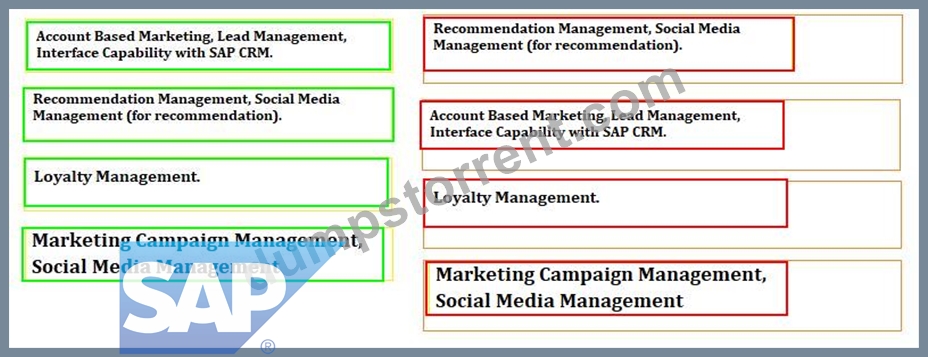
NEW QUESTION # 33
Which artifacts does SAP provide as part of the SAP Reference Business Architecture content?
- A. Business Capability Model/Business Data Model/Business Role Model/Product Map
- B. Business Process Model/Solution Process Model
- C. Business Capability Model/Business Process Model
Answer: A
Explanation:
SAP provides a comprehensive set of artifacts as part of its SAP Reference Business Architecture content to support enterprises in designing their business architecture efficiently and effectively. The correct answer, A, encompasses a broad range of these artifacts:
Business Capability Model: Defines the capabilities an organization requires to achieve its business objectives and outcomes.
Business Data Model: Outlines the structure of the data elements within an organization and their relationships.
Business Role Model: Describes roles within the organization and their responsibilities.
Product Map: Provides an overview of the products and services an organization offers and how they relate to business capabilities and processes.
These artifacts are foundational for understanding and designing the enterprise's business architecture, ensuring alignment with strategic goals, technological capabilities, and operational processes.
Reference:
SAP Reference Architecture documentation.
SAP Business Architecture Services.
NEW QUESTION # 34
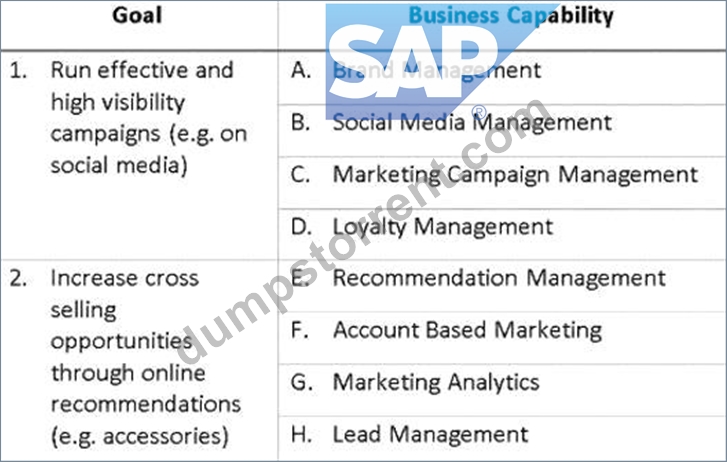
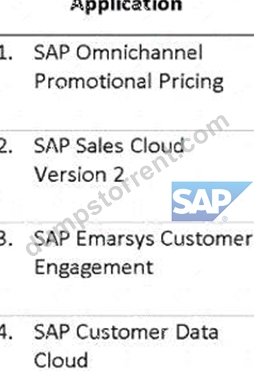
The Wanderlust CIO, along with you, the Chief Enterprise Architect, are in the process of deciding on the application that can potentially replace your existing online marketing application, and you are trying to create the artifact Business Footprint Diagram for decision support ( See table below) Which of the following combinations of goals, business capabilities, and applications would you recommend?
Note: There are 2 correct answers to this question,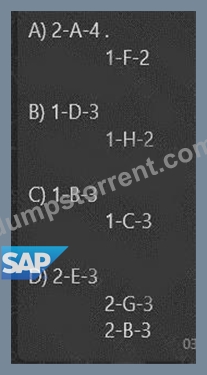
- A. 2-A-4,1-F-2
- B. 2-E-3,2-G-3,2-B-3
- C. 1-B-3,1-C-3
- D. 1-D-3,1-H-2
Answer: A,C
NEW QUESTION # 35
What kind of applications can you develop with SAP Business Application Studio?
- A. ABAP applications
- B. SAPUI5 (SAP Fiori) applications
- C. SAPUI5 (SAP Fiori) applications and ABAP applications
Answer: C
Explanation:
Explanation
SAP Business Application Studio is a cloud-based development environment that can be used to develop SAPUI5 (SAP Fiori) applications and ABAP applications. It provides a wide range of features and tools that can help developers to create high-quality applications quickly and easily.
SAPUI5 applications are web-based applications that are built using the SAPUI5 framework. They are typically used to provide users with a modern and user-friendly interface to SAP applications.
ABAP applications are traditional SAP applications that are written in the ABAP programming language.
They are typically used to implement business logic and to interact with SAP data.
SAP Business Application Studio also provides support for other types of applications, such as Node.js applications and Python applications. However, it is most commonly used to develop SAPUI5 and ABAP applications.
Here are some of the features and tools that are available in SAP Business Application Studio:
A code editor with syntax highlighting and code completion.
A debugger that allows developers to step through code and debug errors.
A test runner that allows developers to run unit tests and integration tests.
A deployment manager that allows developers to deploy applications to SAP Cloud Platform.
A library of pre-built components that can be used to speed up development.
SAP Business Application Studio is a powerful development environment that can be used to create a wide range of applications. It is a good choice for developers who want to create SAPUI5 and ABAP applications.
NEW QUESTION # 36
Which of the following are the best architectural decisions for an extension application in S/4HANA?
- A. Use "Developer Extensibility for data-intensive ABAP extensions to S/4HANA./Use "Side-by-Side Extensibility on SAP BTP ABAP Environment" when additional SAP BTP services are intensively used and SAPUI5 user interfaces are required.
- B. Use "Developer Extensibility for ABAP extensions to S/4HANA that do not require a UI component./Use "Side-by-Side Extensibility on SAP BTP, ABAP Environment" for extensions that require a SAPUI5 based user interface.
- C. Use 'Developer Extensibility" for data-intensive ABAP extensions to S/4HANA./Use "Side-by-Side Extensibility on SAP BTP. ABAP Environment" for applications that are less data-intensive and SAP BTP services that are intensively used.
Answer: A
Explanation:
The decision for the extension model in S/4HANA should be based on the nature of the extension required. Developer Extensibility (in-app extensibility) is suitable for data-intensive extensions that need to operate within the context of S/4HANA. This is because it allows for direct access to S/4HANA's digital core and leverages the power of the HANA database. It is the recommended approach when the extension requires tight integration with core data and processes, ensuring high performance and data consistency.
On the other hand, Side-by-Side Extensibility on SAP BTP ABAP Environment is recommended when the extensions need to utilize additional SAP BTP services such as advanced analytics, machine learning, IoT services, or when creating new user experiences with SAPUI5. This decouples the extensions from the S/4HANA core, which can be beneficial in terms of flexibility, agility, and reducing the impact on the core system during upgrades.
Reference = These practices are supported by SAP's extensibility guide for S/4HANA, which explains the two extensibility models and their appropriate use cases. SAP documentation on ABAP Platform extensibility options provides further insights into when to choose each extensibility approach. SAP Best Practices for Extensibility in SAP S/4HANA guide provides a comprehensive view on how to extend the digital core effectively while maintaining system integrity and upgradeability.
NEW QUESTION # 37
......
P-SAPEA-2023 Actual Questions Answers PDF 100% Cover Real Exam Questions: https://braindumps2go.dumpstorrent.com/P-SAPEA-2023-exam-prep.html