

(2026) PASS NSK300 exam with Netskope NSK300 Real Exam Questions
Real exam questions are provided for Netskope NCCSA tests, which can make sure you 100% pass
Netskope NSK300 Exam Syllabus Topics:
| Topic | Details |
|---|---|
| Topic 1 |
|
| Topic 2 |
|
| Topic 3 |
|
| Topic 4 |
|
| Topic 5 |
|
NEW QUESTION # 24
You are using Netskope CSPM for security and compliance audits across your multi-cloud environments. To decrease the load on the security operations team, you are researching how to auto-re mediate some of the security violations found in low-risk environments.
Which statement is correct in this scenario?
- A. You can use Netskope Auto-remediation frameworks from the public Netskope GitHub Open Source repository for auto-re mediation of security violation results.
- B. Netskope does not support automatic remediation of security violation results due to the high risk associated with it.
- C. You can use Netskope API-enabled Protection for auto-remediation of security violation results.
- D. You can use Netskope Cloud Exchange for auto-remediation of security violation results.
Answer: A
Explanation:
Netskope supports automatic remediation of security violations through its Auto-Remediation frameworks, which are available in the public Netskope GitHub Open Source repository. These frameworks allow for the automatic mitigation of risks associated with security misconfigurations in your cloud environment. The Netskope Auto-Remediation framework for AWS, for example, deploys a set of AWS Lambda functions that query the Netskope API at scheduled intervals and automatically mitigates supported violations1. Similarly, there are frameworks for GCP and other cloud environments that follow the same principle2. This capability is particularly useful for low-risk environments where the security operations team's workload can be reduced by automating the remediation process.
NEW QUESTION # 25
You do not want a scheduled Advanced Analytics dashboard to be automatically updated when Netskope makes improvements to that dashboard. In this scenario, what would you do to retain the original dashboard?
- A. Ask Netskope Support to provide the dashboard and import into your Personal folder.
- B. Create a new dashboard from scratch that mimics the Netskope dashboard you want to use.
- C. Download the dashboard you want and Import from File into your Group or Personal folder.
- D. Copy the dashboard into your Group or Personal folders and schedule from these folders.
Answer: D
Explanation:
Netskope's Advanced Analytics platform includes a set of scheduled dashboards that may be updated by Netskope when the platform releases improvements to pre-built content. If an organization wants to preserve a specific version of a dashboard and prevent automatic updates from modifying it, the recommended approach is to copy the dashboard into a Group or Personal folder. Dashboards stored in these folders are user-managed and are not subject to Netskope's automatic update cycle. Once copied, the scheduled delivery can be configured from the Group or Personal folder version. Creating a new dashboard from scratch, importing from a file, or relying on Netskope Support are less efficient methods, though copying to a personal folder remains the most straightforward and officially supported workflow.
NEW QUESTION # 26
Users in your network are attempting to reach a website that has a self-signed certificate using a GRE tunnel to Netskope. They are currently being blocked by Netskope with an SSL error. How would you allow this traffic?
- A. Set the No SNI setting in Netskope to Bypass.
- B. Ensure that the users add the self-signed certificate to their local certificate store.
- C. Configure a Do Not Decrypt SSL Decryption rule to allow traffic to pass.
- D. Configure a Real-time Protection policy with the action set to Allow.
Answer: C
Explanation:
To allow traffic from a website with a self-signed certificate that is being blocked by Netskope with an SSL error, the correct action is to configure a Do Not Decrypt SSL Decryption rule. This rule will allow the traffic to pass without being decrypted, thus bypassing the SSL error caused by the self-signed certificate. This is a common practice for handling traffic from trusted internal applications or specific external sites that use self-signed certificates1.
NEW QUESTION # 27
Your organization ' s software deployment team did the initial install of the Netskope Client with SCCM. As the Netskope administrator, you will be responsible for all up-to-date upgrades of the client.
Which two actions would be required to accomplish this task? (Choose two.)
- A. Set the installmode-IDP flag during the original Install.
- B. In the Client Configuration, set Upgrade Client Automatically to Latest Release.
- C. In the Client Configuration, set Upgrade Client Automatically to Specific Golden Release.
- D. Set the autoupdate-on flag during the original Install.
Answer: B,D
Explanation:
When deploying the Netskope Client via SCCM and requiring that the Netskope administrator manage future client upgrades, two actions are necessary. First, the "autoupdate=on" flag must be set during the original MSI installation; this parameter enables the auto-update capability in the client so it can receive upgrade instructions from the tenant. Second, in the Netskope UI under Client Configuration, the "Upgrade Client Automatically" option must be set to "Latest Release" or a designated "Specific Golden Release," depending on the desired update policy. Without the autoupdate flag set at installation time, the tenant-side upgrade setting has no effect on the deployed client. The installmode=IDP flag is relevant to IDP-based authentication scenarios and is not related to auto-update functionality.
NEW QUESTION # 28 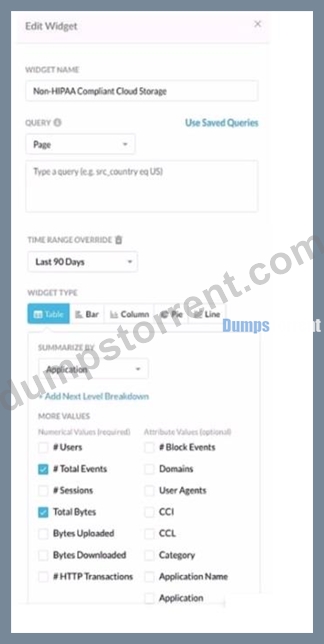
Review the exhibit.
You work for a medical insurance provider. You have Netskope Next Gen Secure Web Gateway deployed to all managed user devices with limited block policies. Your manager asks that you begin blocking Cloud Storage applications that are not HIPAA compliant Prior to implementing this policy, you want to verify that no business or departmental applications would be blocked by this policy.
Referring to the exhibit, which query would you use in the Edit Widget window to narrow down the results?
- A. app-compliance does not contain HIPAA and category must equal Cloud Storage
- B. app-ccl-compliance-cert neq ' HIPAA ' and category eq ' Cloud Storage '
- C. Cloud Confidence Compliance neq HIPAA and Cloud Confidence Category is Cloud Storage
- D. SELECT application WHERE ' HIPAA ' NOT IN app-cci-compliance AND WHERE ' Cloud Storage ' IN category
Answer: B
Explanation:
To identify which cloud storage applications are currently in use but are not HIPAA compliant before implementing a blocking policy, administrators can leverage Netskope's Advanced Analytics with a targeted query. The correct query syntax for this use case is: app-cci-compliance-cert neq 'HIPAA' and category eq ' Cloud Storage'. This query uses the Cloud Confidence Index (CCI) compliance certification field to filter out applications that do not hold a HIPAA certification, scoped to the Cloud Storage application category. This allows administrators to see active usage of non-compliant cloud storage applications and assess the business impact before applying an enforcement policy. The other options contain incorrect field names or invalid syntax that would not return valid results in Netskope's query engine.
NEW QUESTION # 29
A company's architecture includes a server subnet that is logically isolated from the rest of the network with no Internet access, no default gateway, and no access to DNS. New resources can only be provisioned on virtual resources in that segment and there is a firewall that is tunnel-capable securing the perimeter of the segment. The only requirement is to have content filtering for any server that might access the Internet using a browser.
Which two Netskope deployment methods would achieve this requirement? (Choose two.)
- A. Deploy a mobile profile on the servers.
- B. Deploy IPsec or GRE tunnels in the segment to steer traffic from the servers to Netskope.
- C. Install the Netskope Client on the servers
- D. Deploy Data Plane on Premises (DPoP) with a proxy configuration on the servers.
Answer: B,D
Explanation:
For a server subnet that is isolated and requires content filtering for any server that might access the Internet using a browser, the two Netskope deployment methods that would meet this requirement are:
* B. Deploy Data Plane on Premises (DPoP) with a proxy configuration on the servers: Deploying DPoP would allow the isolated servers to connect to the Netskope cloud for content filtering through a proxy configuration.This setup would enable the servers to have controlled access to the Internet for content filtering purposes without requiring direct Internet access1.
* C. Deploy IPsec or GRE tunnels in the segment to steer traffic from the servers to Netskope: By deploying IPsec or GRE tunnels, the traffic from the servers can be securely directed to Netskope for content filtering.This method is suitable for environments where servers do not have direct Internet access, as the tunnel provides a secure path for traffic to reach Netskope's cloud services1.
These deployment methods are designed to work in environments with strict network isolation and provide the necessary content filtering capabilities for servers accessing the Internet.
The deployment methods and their suitability for isolated server subnets are based on Netskope's documentation and resources, which detail various deployment options and their use cases21.
NEW QUESTION # 30
Your organization recently purchased Netskope API SharePoint for Business to get a better understanding of how much intellectual property is being stored in the platform. Your CISO wants to ensure that the current investment will be fully maximized and asks you to provide other use cases that the API can solve. In this scenario, what are two other benefits of this API? (Choose two.)
- A. Discover malware files.
- B. Audit all activities associated with your sensitive content.
- C. Prevent users from adding any new files to a SharePoint site.
- D. Prevent downloads of your sensitive content to personal machines.
Answer: A,B
Explanation:
Netskope's API Data Protection for SharePoint Online provides several capabilities beyond basic content discovery and inventory scanning. Two additional use cases that deliver tangible value are: auditing all user activities associated with sensitive content, including access, sharing, and modification events tracked through SharePoint's audit logs as consumed by Netskope; and discovering malware files stored within SharePoint, where Netskope's API scanning engine identifies malicious files at rest using threat intelligence feeds and antivirus scanning. Preventing downloads to personal machines is a function of inline Real-time Protection or Reverse Proxy policies, not the API integration. Preventing users from adding new files is also an inline enforcement capability and falls outside the scope of API Data Protection functionality.
NEW QUESTION # 31
Review the exhibit.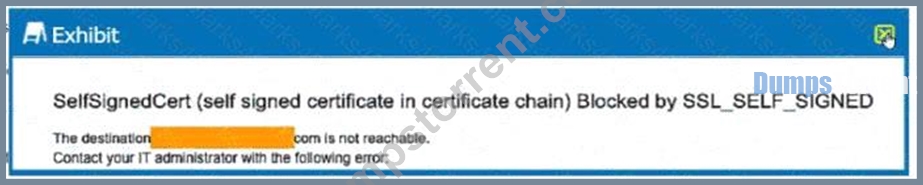
You are the proxy administrator for a medical devices company. You recently changed a pilot group of users from cloud app steering to all Web traffic. Pilot group users have started to report that they receive the error shown in the exhibit when attempting to access the company intranet site that is publicly available. During troubleshooting, you realize that this site uses your company's internal certificate authority for SSL certificates.
Which three statements describe ways to solve this issue? (Choose three.)
- A. Bypass SSL inspection for the affected site(s).
- B. Import the root certificate for your internal certificate authority into Netskope.
- C. Instruct the user to proceed past the error message
- D. Change the SSL Error Settings from Block to Bypass in the Netskope tenant.
- E. Create a Real-time Protection policy to allow access.
Answer: A,B,D
Explanation:
* A. Import the root certificate for your internal certificate authority into Netskope:
* This step ensures that Netskope recognizes and trusts SSL certificates issued by your company's internal certificate authority. By importing the root certificate, you enable proper SSL inspection and validation for internal sites.
* B. Bypass SSL inspection for the affected site(s):
* Since the intranet site uses your company's internal certificate authority, bypassing SSL inspection for this specific site allows users to access it without encountering SSL errors.
* D. Change the SSL Error Settings from Block to Bypass in the Netskope tenant:
* Adjusting the SSL Error Settings to "Bypass" allows users to proceed past SSL errors, including self-signed certificate errors. This ensures uninterrupted access to the intranet site. References:
* Netskope Security Cloud Introductory Online Technical Training
* Netskope Security Cloud Operation & Administration (NSCO&A) - Classroom Training
* Netskope Cloud Security Certification Program
NEW QUESTION # 32
You want to verify that Google Drive is being tunneled to Netskope by looking in the nsdebuglog file. You are using Chrome and the Netskope Client to steer traffic. In this scenario, what would you expect to see in the log file?
- A.

- B.

- C.

- D.

Answer: A
Explanation:
When verifying that Google Drive traffic is being tunneled to Netskope using Chrome and the Netskope Client, you would expect to see log entries indicating that the traffic is being directed through Netskope's proxy. Specifically, Option A is correct as it shows the process "google drive" being tunneled to nsProxy. The log entry for Option A indicates that a TLS tunneling flow from a local address and process (Google Drive) is being directed to a host (play.googleapis.com) and then to Netskope's proxy (nsProxy). This is consistent with how Netskope tunnels specified traffic for security and policy enforcement1.
NEW QUESTION # 33
You are troubleshooting an issue with users who are unable to reach a financial SaaS application when their traffic passes through Netskope. You determine that this is because of IP restrictions in place with the SaaS vendor. You are unable to add Netskope's IP ranges at this time, but need to allow the traffic.
How would you allow this traffic?
- A. Use an IPsec tunnel to forward traffic so it will egress from the corporate data center
- B. Use Explicit Proxy Over Tunnel (EPoT) so the traffic will egress from the corporate data center.
- C. Use NPAto implement Source IP anchonng so the traffic will egress from the corporate data center.
- D. Use Cloud Explicit Proxy so the traffic will egress from the corporate data center
Answer: D
Explanation:
To allow traffic to a financial SaaS application that is being blocked due to IP restrictions, the best option is to useCloud Explicit Proxy. This method allows traffic to egress from the corporate data center without requiring Netskope's IP ranges to be added to the SaaS vendor's allowlist.By configuring an allowlist in the Cloud Explicit Proxy settings, you can add any source egress IP addresses for your on-premises users, and Netskope will allow the traffic from the added user and IP address without authenticating1.
The process for configuring an allowlist in Cloud Explicit Proxy to manage unauthenticated traffic from specific IP addresses is detailed in the Netskope Knowledge Portal1. This solution is suitable for scenarios where adding Netskope's IP ranges to the SaaS vendor's IP restrictions is not feasible.
NEW QUESTION # 34
You want to integrate with a third-party DLP engine that requires ICAP. In this scenario, which Netskope platform component must be configured?
- A. Netskope Cloud Exchange
- B. Secure Forwarder
- C. Netskope Adapter
- D. On-Premises Log Parser (OPLP)
Answer: C
Explanation:
Netskope supports integration with third-party Data Loss Prevention engines that communicate using the Internet Content Adaptation Protocol (ICAP). The Netskope Adapter is the platform component that enables this integration by acting as an ICAP server, receiving content from Netskope's inline proxy and forwarding it to the external DLP engine for inspection. The Adapter then receives the DLP response and relays the enforcement decision back to the Netskope platform. This is distinct from Cloud Exchange, which handles log and threat intelligence sharing workflows, and the Secure Forwarder, which is used to steer traffic from on- premises environments without a client. The On-Premises Log Parser (OPLP) is used for ingesting log data from on-premises firewalls or proxies into Netskope telemetry.
NEW QUESTION # 35
You configured a pair of IPsec funnels from the enterprise edge firewall to a Netskope data plane. These tunnels have been implemented to steer traffic for a set of defined HTTPS SaaS applications accessed from end-user devices that do not support the Netskope Client installation. You discover that all applications steered through this tunnel are non-functional.
According to Netskope. how would you solve this problem?
- A. Install the Netskope root and intermediate certificates on the end-user devices.
- B. Restart the tunnel to stop the tunnel from flapping.
- C. Downgrade from IKE v2 to IKE v1.
- D. Disable Perfect Forward Secrecy on the tunnel configuration.
Answer: A
Explanation:
When IPsec tunnels are used to steer HTTPS traffic from end-user devices to Netskope, the Netskope platform performs SSL inspection as part of its inline proxy function. This requires that the Netskope root and intermediate SSL certificates be trusted by the endpoint devices connecting through the tunnel. When these certificates are not installed in the device's trusted certificate store, the SSL inspection process causes certificate errors, rendering the inspected applications non-functional. Installing the Netskope certificate chain on the affected devices resolves this issue by allowing the device to trust the Netskope-generated certificates presented during SSL decryption. This is a standard requirement for any transparent SSL proxy deployment and is explicitly documented in Netskope's certificate management guidance.
NEW QUESTION # 36
You configured a pair of IPsec funnels from the enterprise edge firewall to a Netskope data plane. These tunnels have been implemented to steer traffic for a set of defined HTTPS SaaS applications accessed from end-user devices that do not support the Netskope Client installation. You discover that all applications steered through this tunnel are non-functional.
According to Netskope. how would you solve this problem?
- A. Install the Netskope root and intermediate certificates on the end-user devices.
- B. Restart the tunnel to stop the tunnel from flapping.
- C. Downgrade from IKE v2 to IKE v1.
- D. Disable Perfect Forward Secrecy on the tunnel configuration.
Answer: A
Explanation:
When applications steered through an IPsec tunnel are non-functional, it is often due to the lack of proper trust establishment between the end-user devices and the Netskope data plane. The solution is to install the Netskope root and intermediate certificates on the end-user devices . This ensures that the devices recognize and trust the encrypted connection established by the IPsec tunnel, allowing the HTTPS SaaS applications to function correctly. Without these certificates, the devices may not be able to verify the security of the connection, leading to application failures.
This solution is based on standard practices for securing IPsec tunnels and ensuring device compatibility with encrypted traffic steering, as outlined in Netskope's documentation on traffic steering and IPsec configuration
NEW QUESTION # 37
You want to enable the Netskope Client to automatically determine whether it is on-premises or off-premises. Which two options in the Netskope Ul would you use to accomplish this task? (Choose two.)
- A. the New Exception option in the Traffic Steering options of the Ul
- B. the On Premises Detection option under the Client Configuration section of the Ul
- C. the All Traffic option in the Steering Configuration section of the Ul
- D. the Enable Dynamic Steering option in the Steering Configuration section of the Ul
Answer: B,D
Explanation:
To enable the Netskope Client to automatically determine whether it is on-premises or off-premises, you can use the following options in the Netskope UI:
Enable Dynamic Steering:
This option is available in the Steering Configuration section of the UI.
By enabling dynamic steering, the Netskope Client can intelligently determine the appropriate data plane (on-premises or cloud) based on the user's location and network conditions.
It ensures that traffic is directed to the optimal data plane for improved performance and security.
Reference:
On Premises Detection:
This option is available under the Client Configuration section of the UI.
By configuring on-premises detection, the Netskope Client can identify whether it is connected to the local network (on-premises) or accessing resources from outside (off-premises).
It helps in applying relevant policies and steering traffic accordingly.
NEW QUESTION # 38
You deployed Netskope Cloud Security Posture Management (CSPM) using pre-defined benchmark rules to monitor your cloud posture in AWS, Azure, and GCP. You are asked to assess if you can extend the Netskope CSPM solution by creating custom rules for each environment.
Which statement is correct?
- A. Custom rules using Domain Specific Language are only available when using SSPM.
- B. With Netskope CSPM, you can create custom rules using Domain Specific Language for AWS. Azure, and GCP
- C. With Netskope CSPM, you can create custom rules using Domain Specific Language for AWS. Azure, but not for GCP.
- D. You will need to evaluate SaaS Security Posture Management (SSPM) in addition to CSPM so that rules applied to GCP will align with Google Workspace
Answer: B
Explanation:
Netskope's Cloud Security Posture Management (CSPM) solution supports the creation of custom compliance rules using Domain Specific Language (DSL) across all three major public cloud providers: Amazon Web Services (AWS), Microsoft Azure, and Google Cloud Platform (GCP). This allows organizations to define bespoke security policies beyond the pre-built compliance benchmarks such as CIS, PCI-DSS, or HIPAA that come packaged with the platform. DSL-based custom rules give security architects the flexibility to encode organization-specific controls and automate posture assessment across multi-cloud environments. SSPM is a separate product focused on SaaS application posture management and is not a prerequisite or alternative for GCP custom rule creation within the CSPM module.
NEW QUESTION # 39
Review the exhibit.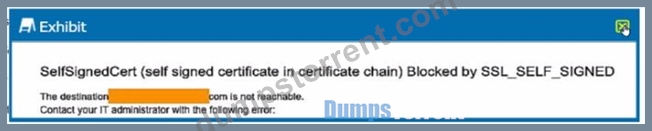
You are the proxy administrator for a medical devices company. You recently changed a pilot group of users from cloud app steering to all Web traffic. Pilot group users have started to report that they receive the error shown in the exhibit when attempting to access the company intranet site that is publicly available. During troubleshooting, you realize that this site uses your company's internal certificate authority for SSL certificates.
Which three statements describe ways to solve this issue? (Choose three.)
- A. Bypass SSL inspection for the affected site(s).
- B. Import the root certificate for your internal certificate authority into Netskope.
- C. Instruct the user to proceed past the error message
- D. Change the SSL Error Settings from Block to Bypass in the Netskope tenant.
- E. Create a Real-time Protection policy to allow access.
Answer: A,B,D
Explanation:
A . Import the root certificate for your internal certificate authority into Netskope:
This step ensures that Netskope recognizes and trusts SSL certificates issued by your company's internal certificate authority. By importing the root certificate, you enable proper SSL inspection and validation for internal sites.
B . Bypass SSL inspection for the affected site(s):
Since the intranet site uses your company's internal certificate authority, bypassing SSL inspection for this specific site allows users to access it without encountering SSL errors.
D . Change the SSL Error Settings from Block to Bypass in the Netskope tenant:
Adjusting the SSL Error Settings to "Bypass" allows users to proceed past SSL errors, including self-signed certificate errors. This ensures uninterrupted access to the intranet site. Reference:
Netskope Security Cloud Introductory Online Technical Training
Netskope Security Cloud Operation & Administration (NSCO&A) - Classroom Training Netskope Cloud Security Certification Program
NEW QUESTION # 40
You have enabled CASB traffic steering using the Netskope Client, but have not yet enabled a Real-time Protection policy. What is the default behavior of the traffic in this scenario?
- A. Traffic will be allowed and logged.
- B. Traffic will be blocked and logged.
- C. Traffic will be allowed, but not logged.
- D. Traffic will be blocked, but not logged.
Answer: A
Explanation:
In the scenario where CASB traffic steering is enabled using the Netskope Client without a Real-time Protection policy being activated, the default behavior of the traffic is toallow and log it (B). This means that the traffic will not be blocked; instead, it will be permitted to pass through and will be recorded for monitoring and analysis purposes.This default setting ensures visibility into the traffic and user activities without immediately enforcing a block, allowing for a period of observation and policy tuning before potentially more restrictive actions are taken1.
The default behavior of traffic steering in Netskope, including the logging of allowed traffic, is detailed in Netskope's best practices and community discussions on Real-time Protection policies1.
NEW QUESTION # 41
Your Netskope Client tunnel has connected to Netskope; however, the user is not receiving any steering or client configuration updates What would cause this issue?
- A. The Netskope Client service is not running.
- B. An invalid steering exception was created in the tenant
- C. The client is unable to establish communication to gateway-(tenant|.goskope.com.
- D. The client is unable to establish communication to add-on-[tenantl.goskope.com.
Answer: A
Explanation:
When the Netskope Client service is not running, it cannot execute the necessary processes to receive steering or client configuration updates. The service must be active to establish communication with the Netskope cloud and apply the configurations and policies defined by the administrator.
This information aligns with the Netskope Cloud Security Architect learning objectives and documents, which emphasize the importance of running client services for proper communication and functionality
NEW QUESTION # 42
You have users connecting to Netskope from around the world You need a way for your NOC to quickly view the status of the tunnels and easily visualize where the tunnels are located. Which Netskope monitoring tool would you use in this scenario?
- A. Network Events in Skope IT
- B. Alerts in Skope IT
- C. Web Usage Summary in Advanced Analytics
- D. Network Steering in Digital Experience Management
Answer: D
Explanation:
Netskope's Digital Experience Management (DEM) module provides comprehensive visibility into the performance and health of network connections, including IPsec and GRE tunnels. The "Network Steering" section within DEM offers a geographic visualization of active tunnels and their status, allowing NOC teams to quickly identify tunnel locations on a map and assess their operational state. This provides immediate situational awareness without requiring manual log queries or scripted health checks. Skope IT Network Events provides event-level data but does not offer the visual map-based representation needed for efficient operational monitoring at scale. Advanced Analytics Web Usage Summary is focused on user activity trends, not infrastructure connectivity status.
NEW QUESTION # 43
Your client is an NG-SWG customer. They are going to use the Explicit Proxy over Tunnel (EPoT) steering method. They have a specific list of domains that they do not want to steer to the Netskope Cloud.
What would accomplish this task''
- A. Create a real-time policy with a bypass action.
- B. Define exceptions in the Netskope steering configuration
- C. Define exception domains in the PAC file.
- D. Use an SSL decryption policy.
Answer: C
Explanation:
To accomplish the task of not steering specific domains to the Netskope Cloud while using the Explicit Proxy over Tunnel (EPoT) steering method, you would define exception domains in the PAC file (A). This is because the PAC file is used to specify which domains should bypass the proxy and connect directly, thus allowing for granular control over the traffic that is steered to Netskope1.
NEW QUESTION # 44
......
Latest NSK300 Pass Guaranteed Exam Dumps Certification Sample Questions: https://braindumps2go.dumpstorrent.com/NSK300-exam-prep.html