

Brilliant NSE6_FSW-7.2 Exam Dumps Get NSE6_FSW-7.2 Dumps PDF
NSE6_FSW-7.2 Dumps PDF - NSE6_FSW-7.2 Real Exam Questions Answers
To prepare for the Fortinet NSE6_FSW-7.2 certification exam, you should have a deep understanding of FortiSwitch 7.2 technology and be familiar with the Fortinet NSE program. You should also have hands-on experience in configuring and managing FortiSwitch 7.2 solutions. Fortinet offers a variety of training courses and resources to help you prepare for the exam, including online courses, instructor-led training, and self-paced study materials.
Fortinet NSE6_FSW-7.2 (Fortinet NSE 6 - FortiSwitch 7.2) Exam is an industry-recognized certification that validates the skills and knowledge of network professionals in deploying, configuring, and maintaining FortiSwitch products. NSE6_FSW-7.2 exam is designed for IT professionals who specialize in the implementation and management of network infrastructure and security solutions. Fortinet NSE 6 - FortiSwitch 7.2 certification is ideal for those who want to demonstrate their expertise in FortiSwitch products and enhance their career prospects.
NEW QUESTION # 27
Which two statements about the FortiLink authorization process are true? (Choose two.)
- A. The administrator must manually pre-authorize FortiGate on FortiSwitch by adding the FortiGate serial number.
- B. FortiSwitch requires a reboot to complete the authorization process.
- C. A FortiLink frame is sent by FortiGate to FortiSwitch to complete the authorization.
- D. FortiLink authorization sets the FortiSwitch management mode to FortiLink.
Answer: C,D
Explanation:
The FortiLink authorization process is an integral part of setting up FortiSwitch to be managed by FortiGate. The correct statements regarding the FortiLink authorization process are:
C . A FortiLink frame is sent by FortiGate to FortiSwitch to complete the authorization. This is a part of the FortiLink protocol, where FortiGate communicates with the connected FortiSwitch to establish management and control. This frame initiates the configuration and management process, allowing FortiGate to effectively control the switch.
D . FortiLink authorization sets the FortiSwitch management mode to FortiLink. Once authorized, the management mode of FortiSwitch is set to FortiLink, indicating that it is being managed via a FortiLink connection from a FortiGate appliance. This changes the operational mode of the switch to be under the control of the FortiGate for centralized management and policy application.
Reference:
Further details on the FortiLink setup and authorization process can be accessed through the FortiGate configuration guides available on the Fortinet Documentation site.
NEW QUESTION # 28
Refer to the exhibits.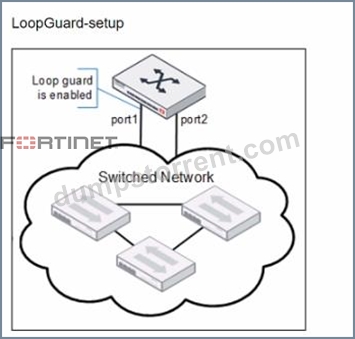
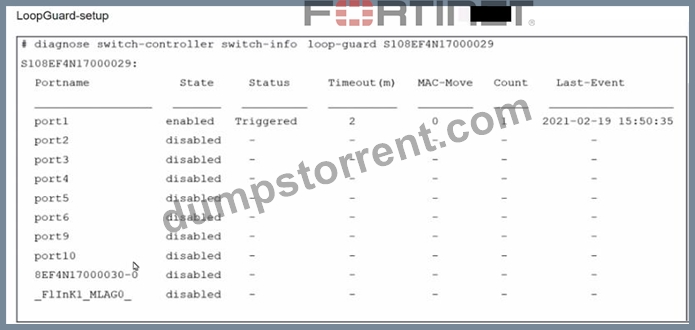
Port1 and port2 are the only ports configured with the same native VLAN 10.
What are two reasons that can trigger port1 to shut down? (Choose two.)
- A. port1 was shut down by loop guard protection.
- B. An endpoint sent a BPDU on port1 that it received from another interface.
- C. Loop guard frame sourced from port 1 was received on port 1.
- D. STP triggered a loop and applied loop guard protection on port1.
Answer: A,D
Explanation:
When loop guard is enabled on port1 and port2 configured with the same native VLAN (VLAN 10), there are specific scenarios under which port1 can be shut down due to loop guard operation:
A . port1 was shut down by loop guard protection. Loop guard is a specific feature used in network environments to prevent alternative or redundant loops. When loop guard is active, it can shut down a port if it stops receiving BPDU (Bridge Protocol Data Units) on a port that is expected to receive them, assuming a loop or link failure and putting the port into an inconsistent state to prevent potential loops.
B . STP triggered a loop and applied loop guard protection on port1. If the Spanning Tree Protocol (STP) detects a loop or loss of BPDU transmissions while loop guard is enabled, it will proactively shut down the port to prevent network instability or a broadcast storm. This is an essential function of loop guard within the context of STP, providing additional protection against topology changes that could introduce loops.
Reference:
Additional details about loop guard functionality and STP interaction can be found in the FortiSwitch administration guides, accessible via Fortinet Documentation.
NEW QUESTION # 29
In which two ways can you assign a FortiSwitch port to a VDOM using multi-tenancy setup? (Choose two.)
- A. Assign a port to a VDOM directly on the managed FortiSwitch.
- B. Remove the managed FortiSwitch and allocate ports directly on FortiSwitch.
- C. Create a virtual port pool on the FortiGate CLI.
- D. Switch the FortiLink interface to the target VDOM.
Answer: A,C
NEW QUESTION # 30
Exhibit.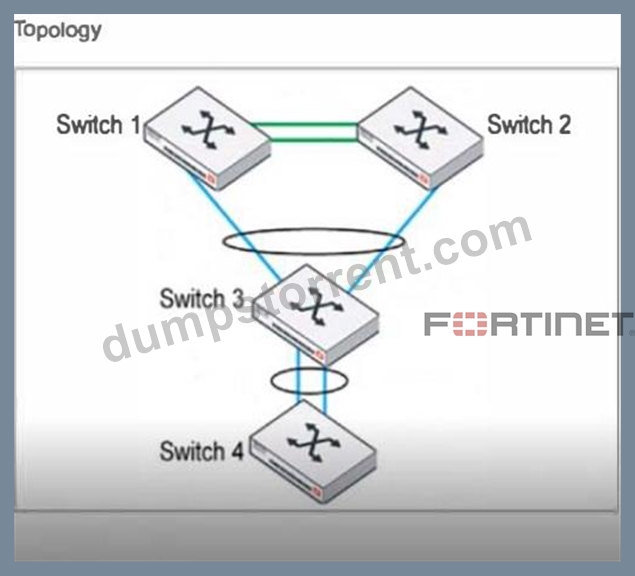
LAG and MCLAG are used to increase the available network bandwidth and enable redundancy. How does spanning tree protocol see MCLAG and LAG if they are configured based on the physi-cal view shown in the exhibit? (Choose two)
- A. Switch 1 and Switch 2 both seen as one single switch.
- B. Switch 3 and switch 4 are seen as one MCLAG switch client
- C. Switch 1. Switch 2, and Switch 3 are seen as one MCLAG peer group
- D. Switch 3 and Switch 4 uplinks are treated as single interfaces.
Answer: A,B
NEW QUESTION # 31
What can an administrator do to maintain the existing standalone FortlSwltch configuration while changing the management mode to FortLink?
- A. Enable the Forti-link setting on FortiSwitch before the authorization process
- B. Use a migration tool based on python script to convert the configuration
- C. FortiGate will automatically save the existing FortiSwitch configuration during the Forti-link management process.
- D. Register FortiSwitch to For1ISwitch Cloud to save a copy before managing by Forti-Gate.
Answer: A
NEW QUESTION # 32
Which Ethernet frame can create Layer 2 flooding due to all bytes on the destination MAC address being set to all FF?
- A. The unicast Ethernet frame
- B. The anycast Ethernet frame
- C. The multicast Ethernet frame
- D. The broadcast Ethernet frame
Answer: D
NEW QUESTION # 33
How does FortiGate handle configuration of flow tracking sampling if you export the settings to a managed FortiSwitch stack with sampling mode set to perimeter is true?
- A. FortiGate configures and enables flow sampling on FortiSwitch but does not change existing sampling settings of interfaces.
- B. FortiGate configures FortiSwitch to perform ingress sampling on all switch interfaces, except ICL and ISL interfaces.
- C. FortiGate configures FortiSwitch to perform ingress sampling on all switch interfaces.
- D. FortiGate configures and enables egress sampling on all management interfaces.
Answer: B
Explanation:
When FortiGate exports configuration settings to a managed FortiSwitch stack with sampling mode set to "perimeter is true," the behavior is:
B . FortiGate configures FortiSwitch to perform ingress sampling on all switch interfaces, except ICL and ISL interfaces. This setting ensures that all incoming traffic on normal operational ports is sampled for monitoring and analysis purposes, but it excludes the inter-chassis link (ICL) and inter-switch link (ISL) interfaces from sampling. These exclusions are typically made to prevent the duplication of sampled data and to reduce unnecessary load on the monitoring system, as these links often carry traffic already monitored at other points.
Options A and D are incorrect because they either generalize the sampling across all interfaces without exceptions or incorrectly specify egress sampling on management interfaces. Option C is also incorrect as FortiGate can modify existing sampling settings to fit the perimeter-based configuration requirement.
NEW QUESTION # 34
Which statement about the IGMP snooping querier when enabled on a VLAN is true?
- A. The setting can only be enabled using the FortiSwitch CLI.
- B. All other indirectly connected switches will be unable to get IGMP multicast traffic.
- C. IGMP reports on the VLAN are forwarded to all switch ports.
- D. Active multicast receiver entries are aging on each IGMP query sent on the VLAN
Answer: B
NEW QUESTION # 35
What are two reasons why time synchronization between FortiGate and its managed FortiSwitch is critical in switch management? (Choose two.)
- A. FortiSwitch will not allow other FortiSwitch devices in the chain be discovered by FortiGate.
- B. FortiSwitch does not retain its time after a reboot, which gets reset after each reboot.
- C. FortiSwitch will not be able to become an NTP server for downstream devices.
- D. FortiSwitch cannot complete the DTLS handshake used in the CAPWAP tunnel.
Answer: B,D
NEW QUESTION # 36
Refer to the exhibit.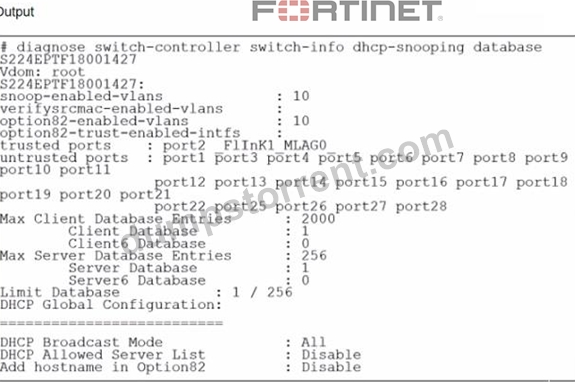
What two conclusions can be made regarding DHCP snooping configuration? (Choose two.)
- A. Global configuration for DHCP snooping is set to forward DHCP client requests on all ports in the VLAN.
- B. DHCP clients that are trusted by DHCP snooping configured is only one.
- C. Maximum value to accept clients DHCP request is configured as per DHCP server range.
- D. FortiSwitch is configured to trust DHCP replies coming on FortiLink interface.
Answer: B,D
NEW QUESTION # 37
Refer to the diagnostic output:
What makes the use of the sniffer command on the FortiSwitch CLI unreliable on__port__23?
- A. Only untagged VLAN traffic can be captured.
- B. The switch port might be used as a trunk member
- C. Just the port egress payloads are printed on CLI.
- D. The types of packets captured is limited.
Answer: D
NEW QUESTION # 38
Which statement about using MAC, IP, and protocol-based VLANs on FortiSwitch is true?
- A. lt is a scalable and secure solution in comparison to other Layer 2 security measures.
- B. It provides benefits that can be obtained when using 802.1X authentication.
- C. Endpoints are required to use the same FortiSwitch port to remain members of the VLAN.
- D. FortiSwitch uses only the Ethernet type to assign traffic to VLANs.
Answer: B
NEW QUESTION # 39
What feature can network administrators use to segment network operations and the administration of managed FortiSwitch devices on FortiGate?
- A. FortiGate clustering protocol
- B. Multi-chassis link aggregation trunk
- C. FortiGate multi-tenancy
- D. FortiLink split interface
Answer: C
Explanation:
FortiGate's multi-tenancy feature, specifically Virtual Domains (VDOMs), is the most appropriate tool for segmenting network operations and the administration of managed FortiSwitch devices on FortiGate. Here's why:
VDOMs as Virtual Firewalls: VDOMs function as independent virtual firewalls within a single FortiGate device. Each VDOM can have its own:
Security policies
Interfaces (Including FortiLink interfaces for FortiSwitch management)
Routing table
Administrative access
Segmenting Network Operations: By assigning different FortiSwitch devices (or groups of ports) to separate VDOMs, you effectively partition your network. Network administrators can manage specific FortiSwitches through their assigned VDOMs, maintaining operational isolation.
Enhanced Administration: VDOMs offer granular administrative control. Different administrators can be assigned to specific VDOMs, limiting their management scope and reducing the risk of accidental configuration changes.
Why Other Options Are Less Suitable:
B . Multi-chassis link aggregation trunk: This focuses on link redundancy and bandwidth aggregation, not network segmentation.
C . FortiGate clustering protocol: This is aimed at high availability and scalability of the firewall functions themselves, not the management of switches.
D . FortiLink split interface: This allows dividing a FortiLink interface on the FortiGate for managing multiple FortiSwitches, but it doesn't provide the true segmentation and administrative isolation that VDOMs offer.
Reference:
Fortinet Document Library - VDOMs: [invalid URL removed]
Fortinet Document Library - FortiSwitch Multi-tenancy (using VDOMS): https://docs.fortinet.com/document/fortiswitch/7.4.2/fortilink-guide/801172/multitenancy-and-vdoms
NEW QUESTION # 40
Exhibit.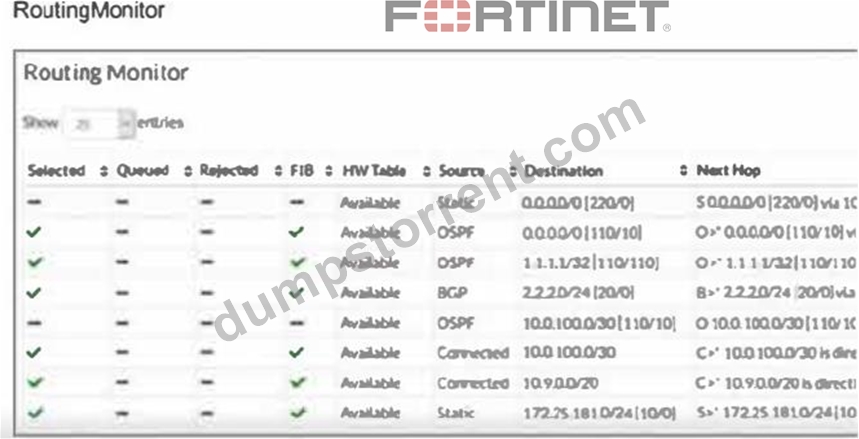
Two routes are not installed in the forwarding information base (FIB) as shown in the exnibit. Which two statements about these two route entries are true? (Choose two.)
- A. These two routes will be used as load-balancing routes.
- B. These two routes will become primary, if the best routes are removed.
- C. These two routes have a higher administrative distance value available to the destination networks.
- D. These two routes are available in the hardware routing table.
Answer: B,C
Explanation:
From the exhibit and the details given about the routes not installed in the FIB:
These two routes have a higher administrative distance value available to the destination networks (Option A): Administrative distance is a measure used by routers to select the best path when there are two or more different routes to the same destination from two different routing protocols. A higher administrative distance means that the route is considered less trustworthy, thus not selected for the FIB unless the more preferred routes fail.
These two routes will become primary, if the best routes are removed (Option B): In routing, if the currently installed routes (which are considered the best due to reasons like lower administrative distance) are removed or become unavailable, the next best routes based on administrative distance will be used. This behavior ensures redundancy and maintains network connectivity in diverse scenarios.
Reference:
This approach is aligned with standard routing protocol behavior as documented in networking protocols and Fortinet's routing mechanisms which prioritize routes based on administrative distance and other metrics to maintain efficient and reliable network routing.
NEW QUESTION # 41
Which drop policy mode, if assigned to a congested port, will drop incoming packets until there is no congestion on the egress port?
- A. Random early detection mode
- B. Tail-drop mode
- C. Weighted round robin mode.
- D. Strict mode
Answer: B
Explanation:
Tail-drop mode is a congestion management technique used in network devices, including FortiSwitches, to handle congestion on network ports:
Tail-Drop Mode (A):
Behavior: When a queue reaches its maximum capacity on a congested port, tail-drop mode simply drops any incoming packets that arrive after the buffer is full. This continues until the congestion is alleviated and there is space in the queue to accommodate new packets.
Application: This is a straightforward approach used when the device's buffer allocated to the port becomes full due to sustained high traffic, preventing buffer overflow and maintaining system stability.
Reference:
For more details on congestion management techniques and settings on FortiSwitch, you can refer to the configuration manuals available on: Fortinet Product Documentation
NEW QUESTION # 42
Refer to the exhibit.
The exhibit shows the current status of the ports on the managed FortiSwitch. Access-1.
Why would FortiGate display a serial number in the Native VLAN column associated with the port23 entry?
- A. port23 is configured as the dedicated management interface.
- B. A standalone switch with the shown serial number is connected on port23.
- C. Ports connected to adjacent FortiSwitch devices show their serial number as the native VLAN.
- D. port23 is a member of a trunk that uses the Access-1 FortiSwitch serial number as the name of the trunk.
Answer: B
NEW QUESTION # 43
What are two reasons why time synchronization between FortiGate and its managed FortiSwitch is critical in switch management? (Choose two.)
- A. FortiSwitch will not allow other FortiSwitch devices in the chain be discovered by FortiGate.
- B. FortiSwitch does not retain its time after a reboot, which gets reset after each reboot.
- C. FortiSwitch will not be able to become an NTP server for downstream devices.
- D. FortiSwitch cannot complete the DTLS handshake used in the CAPWAP tunnel.
Answer: B,D
Explanation:
Time synchronization between FortiGate and its managed FortiSwitch devices is essential for several reasons:
A . FortiSwitch does not retain its time after a reboot, which gets reset after each reboot. This characteristic of FortiSwitch underlines the importance of time synchronization with FortiGate. Since FortiSwitch loses its time settings upon reboot, synchronizing with FortiGate ensures that its system clock is accurate, which is vital for logging, troubleshooting, and security timestamping.
C . FortiSwitch cannot complete the DTLS handshake used in the CAPWAP tunnel. Accurate time synchronization is crucial for security protocols such as DTLS, which rely on timestamped certificates for establishing a secure connection. If the time on FortiSwitch is not synchronized with FortiGate, the DTLS handshake used in the CAPWAP tunnel for secure communication may fail due to time discrepancies, impacting the management and operation of the switch.
NEW QUESTION # 44
Refer to the exhibits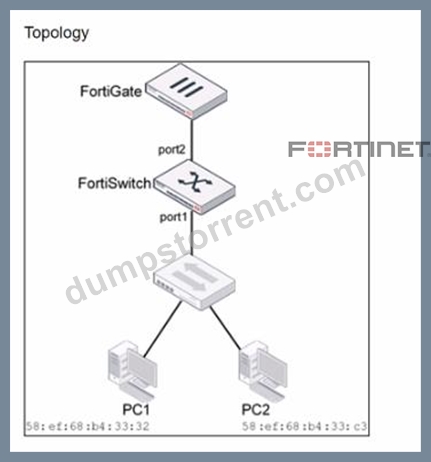
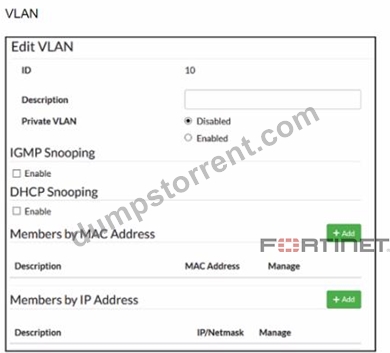
Traffic arriving on port2 on FortiSwitch is tagged with VLAN ID 10 and destined for PC1 connected on port1. PC1 expects to receive traffic untagged from port1 on FortiSwitch.
Which two configurations can you perform on FortiSwitch to ensure PC1 receives untagged traffic on port1? (Choose two.)
- A. Add the MAC address of PCI as a member of VLAN 10.
- B. Add VLAN ID 10 as a member of the untagged VLANs on port1.
- C. Remove VLAN 10 from the allowed VLANs and add it to untagged VLANs on port1.
- D. Enable Private VLAN on VLAN 10 and add VLAN 20 as an isolated VLAN.
Answer: A,B
NEW QUESTION # 45
Exhibit.
LAG and MCLAG are used to increase the available network bandwidth and enable redundancy. How does spanning tree protocol see MCLAG and LAG if they are configured based on the physi-cal view shown in the exhibit? (Choose two)
- A. Switch 3 and Switch 4 uplinks are treated as single interfaces.
- B. Switch 1 and Switch 2 both seen as one single switch.
- C. Switch 3 and switch 4 are seen as one MCLAG switch client
- D. Switch 1. Switch 2, and Switch 3 are seen as one MCLAG peer group
Answer: A,D
Explanation:
In the context of the topology provided and the concepts of LAG (Link Aggregation Group) and MCLAG (Multi-Chassis Link Aggregation), the spanning tree protocol's perspective can be summarized as follows:
Switch 1, Switch 2, and Switch 3 are seen as one MCLAG peer group (Option A): In this configuration, Switches 1 and 2 form a Multi-Chassis Link Aggregation Group (MCLAG) which effectively allows them to act as a single logical entity from the perspective of downstream switches (in this case, Switch 3). This grouping enhances fault tolerance and bandwidth by pooling the link resources of the two switches.
Switch 3 and Switch 4 uplinks are treated as single interfaces (Option B): This option suggests that the connections between Switch 3 and Switch 4 (presumably using LAG) are perceived by the spanning tree protocol as a single logical connection. This perception is due to the LAG configuration, which combines multiple network cables/ports into a single logical link to provide redundancy and increase bandwidth.
Reference:
The use of LAG and MCLAG is well-documented in networking literature and Fortinet's own documentation, as these technologies are commonly employed to enhance redundancy and bandwidth. Fortinet's implementation of these protocols is designed to maintain compatibility with standard networking protocols, including Spanning Tree Protocol (STP).
NEW QUESTION # 46
Which QoS mechanism maps packets with specific CoS or DSCP markings to an egress queue?
- A. Marking for ingress traffic
- B. Classification for ingress traffic
- C. Rate limiting for egress traffic
- D. Queuing for egress traffic
Answer: B
NEW QUESTION # 47
What type of multimode transceiver can be used to split a 40G port?
- A. SFP+ transceiver
- B. SFP transceiver
- C. QSFP transceiver
- D. QSFP+ transceiver
Answer: D
NEW QUESTION # 48
How is traffic routed on FortiSwitch?
- A. ASIC hardware routing can only handle dynamic routing, if supported.
- B. FortiSwitch looks up the hardware routing table and then the forwarding information base (FIB).
- C. Layer 3 routing can be configured on FortiSwitch, while managed by FortiGate.
- D. Hardware-based routing on FortiSwitch is handled by the CPU.
Answer: C
NEW QUESTION # 49
What is the role of a device that is simultaneously functioning as both the distribution and core in the hierarchy network model?
- A. HA backup FortiGate managing FortiSwitch
- B. POE with high density FortiSwitch
- C. FortiGate managing FortiSwitch
- D. FortiSwitch functioning as standalone
Answer: C
Explanation:
In a hierarchical network model, the role of a device functioning simultaneously as both the distribution and core is most accurately described as "FortiGate managing FortiSwitch (B)." In this setup, FortiGate acts as the central unit managing multiple FortiSwitch units, thereby functioning both as a distribution layer-handling traffic between network segments-and as a core layer-managing traffic within the network on a broader scale. This setup is typical in medium-sized networks where a single device is capable enough to handle both roles effectively.
NEW QUESTION # 50
Exhibit.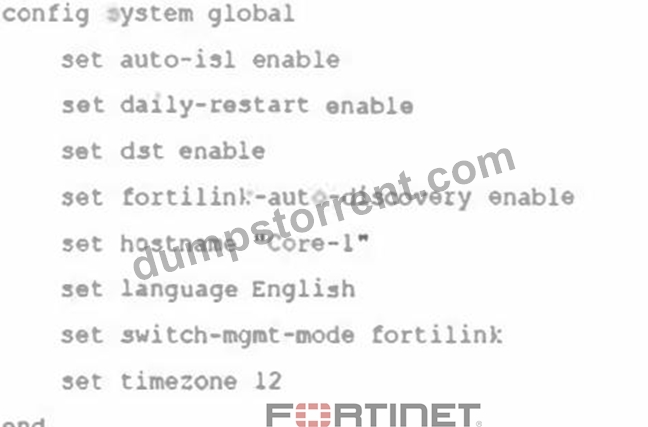
You need to manage three FortiSwitch devices using a FortiGate device. Two of the FortiSwitch devices initiated a reboot after the authorization process. However, the FortiSwitch device with the configuration shown in the exhibit. did not reboot All three devices completed FortiLink manage-ment authorization successfully.
Why did the FortiSwitch device shown in the exhibit not reboot to complete the authorization pro-cess?
The management mode was set to use FortiLink mode.
- A. The system time is not in-sync and is using a non-default value
- B. The management mode was set to use FortiLink mode.
- C. Switch auto-discovery is enabled.
- D. The FortiSwitch device is scheduled to reboot as part the authorization process
Answer: B
NEW QUESTION # 51
......
Valid NSE6_FSW-7.2 Test Answers & Fortinet NSE6_FSW-7.2 Exam PDF: https://braindumps2go.dumpstorrent.com/NSE6_FSW-7.2-exam-prep.html