

Enhance Your Career With Available Preparation Guide for Accounting-for-Decision-Makers Exam
Get Special Discount Offer of Accounting-for-Decision-Makers Certification Exam Sample Questions and Answers
NEW QUESTION # 12
Which body regulates a certified public accounting firm's audit practices when the firm is auditing a large, publicly traded company?
- A. The Internal Revenue Service (IRS)
- B. The Financial Accounting Standards Board (FASB)
- C. The Public Company Accounting Oversight Board (PCAOB)
- D. The Financial Accounting Standards Advisory Council (FASAC)
Answer: C
Explanation:
The correct answer is D. The Public Company Accounting Oversight Board (PCAOB) . The PCAOB was created to oversee the audits of public companies and SEC-registered brokers and dealers in order to protect investors and support the public interest in accurate, independent audit reports. Its responsibilities include registration of audit firms, inspections, enforcement, and audit-related standard-setting. Because the question refers to a CPA firm auditing a large, publicly traded company , PCAOB oversight is the correct regulatory answer.
Option A is incorrect because FASB sets accounting standards, not audit practice regulation for public company auditors. Option B, FASAC , is an advisory council to FASB and does not regulate audit firms.
Option C, the IRS , administers tax laws and does not oversee external audit practices for public companies.
In accounting and auditing, it is essential to distinguish between those who set accounting rules and those who supervise auditors. For publicly traded companies, that audit oversight role belongs to the PCAOB , making Option D the only accurate choice.
NEW QUESTION # 13
Which role do ethical standards have in management accounting?
- A. To prevent all unethical behavior of anyone the management accountant may work with
- B. To provide the management accountant with the ability to know whether a person will act ethically or not
- C. To guide the resolution to possible ethical dilemmas that the managerial accountant may encounter
- D. To provide the management accountant with the ability to work with only companies that follow strict ethical principles
Answer: C
NEW QUESTION # 14
Last year, X Corporation had sales of $500,000 and total expenses of $300,000. A manager of the company is entitled to get a sales commission of 10% of net profit.
What amount of sales commission is to be recognized at year-end?
- A. $20,000
- B. $50,000
- C. $10,000
- D. $30,000
Answer: A
Explanation:
The correct answer is A. $20,000 . First, calculate net profit before the commission:
Net profit = Sales - Total expenses = $500,000 - $300,000 = $200,000
The manager's commission is 10% of net profit , so:
Commission = 10% × $200,000 = $20,000
Therefore, the amount to recognize at year-end is $20,000 . Under accrual accounting, expenses are recognized in the period in which they are incurred, even if they have not yet been paid. Since the company earned the profit during the year and the manager became entitled to the commission based on that profit, the commission expense should be recorded at year-end in the same reporting period. This follows the matching concept, which aligns expenses with the revenues they helped generate.
Option B is incorrect because it represents 10% of sales, not net profit. Option C and Option D do not match the 10% commission calculation based on the stated profit amount. Since the problem clearly says the commission is based on net profit , the correct recognized amount is $20,000 , making Option A correct.
Accounting texts describe net profit as revenues minus expenses.
NEW QUESTION # 15
Which ratio provides a measure of how well a company turns sales into profits?
- A. Return on expenses
- B. Return on profit
- C. Return on sales
- D. Return on costs
Answer: C
Explanation:
The correct answer is A. Return on sales . Return on sales, also called profit margin or net profit margin , measures how effectively a company converts sales revenue into net income. It is commonly calculated as Net income ÷ Sales . OpenStax explains that this ratio shows how much of each sales dollar remains as profit after all expenses, including taxes, have been deducted. A higher ratio generally indicates stronger profitability and better cost control relative to revenue.
Option B, return on costs , is not the standard ratio named in basic financial analysis for this purpose. Option C, return on expenses , is also not the conventional measure used in the ratio formulas you listed. Option D, return on profit , is not a recognized standard profitability ratio in introductory accounting frameworks.
Since the question asks specifically about how well a company turns sales into profits , the ratio that directly measures that relationship is return on sales . This ratio is widely used in financial statement analysis to compare operating performance across periods and across firms, especially within the same industry.
NEW QUESTION # 16
During the year, a company purchased goods on a credit basis for its supplies of $750.
What would be the impact on the accounting equation and financial statement?
- A. Increase in assets by $750 and increase in liability by $750
- B. Decrease in assets by $750 and increase in liability by $750
- C. Decrease in assets by $750 and decrease in liability by $750
- D. Increase in assets by $750 and decrease in liability by $750
Answer: A
Explanation:
The correct answer is C. Increase in assets by $750 and increase in liability by $750 . When a company purchases supplies on credit, it receives an asset now and promises to pay later. The supplies increase the company's assets , and the amount owed to the seller increases liabilities , usually as accounts payable. This keeps the accounting equation balanced:
Assets = Liabilities + Equity
Here, assets rise by $750 and liabilities also rise by $750 , while equity is unchanged at the time of purchase.
OpenStax explains that buying items on account increases the related asset and increases accounts payable.
Option A is incorrect because liabilities do not decrease. Option B is incorrect because assets do not decrease when the company receives supplies. Option D is incorrect because neither side decreases at the moment of purchase. The expense is not recognized immediately unless the supplies are consumed; initially, the company records the asset and the obligation. This is a common transaction used to show how dual effects maintain balance in the accounting equation. Therefore, the correct impact is an increase in assets and an equal increase in liabilities , which is Option C .
NEW QUESTION # 17
What does it mean if a company has a debt ratio of 101.5%?
- A. The company has 1.5% more total liabilities than total assets
- B. The company has 1.5% more total liabilities than gross sales
- C. The company has 1.5% more current liabilities than current assets
- D. The company has 1.5% more total liabilities than net income
Answer: A
Explanation:
The correct answer is B. The company has 1.5% more total liabilities than total assets . The debt ratio is calculated as:
Debt ratio = Total liabilities / Total assets
If the debt ratio is 101.5% , or 1.015 , that means total liabilities are 101.5% of total assets . In other words, liabilities are slightly greater than assets. Specifically, the company has 1.5% more liabilities than assets .
This is an important financial warning sign because it suggests the company may have negative equity .
Since the accounting equation is:
Assets = Liabilities + Owners' equity
if liabilities exceed assets, then owners' equity must be negative. That can indicate financial distress, accumulated losses, or a highly leveraged position.
Option A is incorrect because the debt ratio does not compare liabilities to sales. Option C is incorrect because it does not compare liabilities to net income. Option D is incorrect because the debt ratio uses total liabilities and total assets , not current liabilities and current assets. Therefore, the only correct interpretation of a 101.5% debt ratio is that total liabilities exceed total assets by 1.5% , making Option B correct.
NEW QUESTION # 18
Under the Sarbanes-Oxley Act, which requirement must an accounting firm that audits public companies meet?
- A. The firm cannot provide several nonaudit services such as internal audit outsourcing to its audit clients
- B. The firm cannot be retained only by the CFO
- C. The firm cannot audit a company for more than five years
- D. The firm cannot use any forms of advertising to obtain new audit clients
Answer: A
Explanation:
The correct answer is B . Section 201 of the Sarbanes-Oxley Act and related SEC rules prohibit registered public accounting firms from providing certain nonaudit services to their audit clients because those services could impair auditor independence. The SEC's rulemaking specifically identifies prohibited services, including internal audit outsourcing , among other restricted nonaudit services.
Option A is incorrect because SOX requires lead audit partner rotation , not mandatory rotation of the entire audit firm after five years. Option C is incorrect because SOX does not impose a blanket ban on advertising by audit firms. Option D is also incorrect because while the audit committee, not management alone, plays a central role in hiring and overseeing the external auditor, the statement as written is not the key audit-firm requirement highlighted by SOX in this context. The most specific and widely tested SOX requirement here is the prohibition on certain nonaudit services to audit clients. This rule protects objectivity by preventing the auditor from effectively reviewing its own consulting or internal audit work. Therefore, Option B is correct.
NEW QUESTION # 19
In January of Year 1, a company began doing business as a corporation in order to sell technology-related accessories and services. During its first month of operations, the following events occurred:
January 1
The corporation received $900,000 in cash in exchange for stock issued to stockholders.
January 3
The corporation borrowed $250,000 from a bank. The loan is a four-year loan with an interest rate of 12%, payable each year on January 1 beginning in Year 2.
January 5
The corporation purchased equipment to be used in the business for $200,000 cash.
January 8
The corporation purchased inventory costing $200,000 by paying $120,000 in cash. The remainder was put on credit accounts with suppliers.
January 15
The corporation hired five employees. Each employee will be paid $1,000 at the end of each month.
January 30
The corporation paid $6,000 cash for a one-year insurance policy. The policy period will begin on February 1, Year 1.
What will be the impact of the January 1 event on the company's balance sheet on that date, along with an increase to cash of $900,000?
- A. Loan payable will increase by $900,000
- B. Stockholders' equity will increase by $900,000
- C. Retained earnings will increase by $900,000
- D. Investments will increase by $900,000
Answer: B
Explanation:
The correct answer is A. Stockholders' equity will increase by $900,000 . On January 1, the corporation received cash in exchange for issuing stock. That means the company's assets increase because cash increases, and stockholders' equity also increases because ownership shares were issued. OpenStax explains that when a company issues stock for cash or other assets, the asset account increases and the related equity accounts are credited.
Option B is incorrect because no borrowing occurred on January 1, so loan payable does not increase from that event. Option C is incorrect because "investments" is not the proper classification for the corporation's own issuance of stock in this context. Option D is incorrect because retained earnings increase from profitable operations over time, not from owner contributions or stock issuances. This transaction is a classic example of the accounting equation staying balanced: Assets increase by $900,000 and Stockholders' Equity increases by $900,000 . Therefore, the correct balance sheet effect, along with the rise in cash, is an equal increase in stockholders' equity .
NEW QUESTION # 20
Which organization establishes rules U.S. companies use to record and report accounting transactions?
- A. Internal Revenue Service
- B. Securities and Exchange Commission
- C. Accounting Principles Board
- D. Financial Accounting Standards Board
Answer: D
Explanation:
The correct answer is C. Financial Accounting Standards Board (FASB) . The FASB is the private-sector standard-setting body whose accounting and financial reporting standards are recognized as authoritative U.S.
generally accepted accounting principles (GAAP) for purposes of the federal securities laws. The SEC has explicitly recognized FASB standards as "generally accepted," which is why U.S. companies rely on FASB guidance when recording and reporting accounting transactions.
Option A is incorrect because the Accounting Principles Board (APB) was a former standard-setting body that was replaced by the FASB. Option B, the SEC , does have legal authority over public company reporting, but it does not serve as the primary day-to-day accounting standard setter in the same way FASB does. Option D, the IRS , is responsible for tax administration, not financial accounting standards for general-purpose financial statements. For exam purposes, when the question asks which organization establishes the accounting rules U.S. companies use to record and report transactions, the best and most accurate answer is FASB .
NEW QUESTION # 21
What is true regarding the use of International Financial Reporting Standards (IFRS)?
- A. IFRS are commonly required to be used in Asia
- B. IFRS may be used instead of generally accepted accounting principles (GAAP) by any U.S.-based corporation
- C. IFRS are required to be used by the Securities and Exchange Commission (SEC)
- D. IFRS are seldom used by non-U.S. companies
Answer: A
Explanation:
The correct answer is C. IFRS are commonly required to be used in Asia . IFRS is widely used around the world, and the IFRS Foundation states that companies in more than 140 jurisdictions are required to use IFRS Accounting Standards when reporting their financial health. That broad global adoption includes many Asian jurisdictions, so saying IFRS are commonly required in Asia is accurate.
Option A is incorrect because U.S. domestic issuers are generally required under SEC rules to file financial statements prepared in accordance with U.S. GAAP , not simply choose IFRS instead. Option B is false because IFRS are not seldom used by non-U.S. companies; in fact, they are extensively used internationally.
Option D is incorrect because the SEC does not require IFRS for all issuers; rather, SEC rules generally require U.S. GAAP for domestic registrants, while certain foreign private issuers may use IFRS as issued by the IASB. Therefore, among the listed choices, Option C is the only statement that is broadly correct and consistent with current international reporting practice.
NEW QUESTION # 22
Which two procedures do external auditors use to gain confidence in the quality of a company's financial reporting processes?
Choose 2 answers.
- A. They examine records to support balances and transactions
- B. They poll the public regarding the company's external image
- C. They conduct a customer satisfaction survey
- D. They perform a marketing analysis to determine demand for the company's products or services
- E. They obtain confirmations from third parties the company does business with
Answer: A,E
Explanation:
The correct answers are A and C . External auditors gather audit evidence by examining accounting records and supporting documents and by obtaining evidence directly from third parties . PCAOB standards describe confirmation as a procedure for obtaining audit evidence from a knowledgeable external source, and this is commonly used for items such as cash, receivables, and certain terms of transactions.
Examining records to support balances and transactions is another core audit procedure. Auditors inspect invoices, contracts, bank statements, reconciliations, journals, and other documentation to determine whether reported balances are supported and fairly stated. These procedures directly relate to the reliability of financial reporting. In contrast, customer satisfaction surveys, marketing analysis, and public-image polling may be useful for business strategy or branding, but they are not standard external audit procedures used to support financial statement assertions. Audit work focuses on relevant, reliable evidence tied to existence, completeness, valuation, rights and obligations, and presentation. Therefore, the two valid procedures are examining records and obtaining third-party confirmations , making A and C the correct answers.
NEW QUESTION # 23
Which source of cash is the best indicator of a firm's viability as an ongoing concern?
- A. Cash from production activities
- B. Cash from operating activities
- C. Cash from investing activities
- D. Cash from financing activities
Answer: B
Explanation:
The correct answer is A. Cash from operating activities . Cash generated from operating activities is the best indicator of whether a company can continue as a going concern because it reflects cash produced by the firm' s core day-to-day business operations . OpenStax explains that the operating section shows cash flows generated and used by normal business activities, while investing and financing sections relate to asset purchases/sales and raising or repaying capital. OpenStax also notes that operating cash flow helps indicate the feasibility of continuing and advancing company plans.
Option B is incorrect because financing cash flows can come from borrowing or issuing stock, which may temporarily provide cash without proving the business itself is healthy. Option C is incorrect because investing cash flows often relate to buying or selling long-term assets and do not directly show sustainable operating strength. Option D is not one of the formal statement of cash flows categories under U.S. GAAP.
For evaluating long-term viability, analysts and auditors place the greatest weight on the firm's ability to generate cash internally from operations. Therefore, Cash from operating activities is the best answer.
NEW QUESTION # 24
Which item is an operating activity under a U.S. generally accepted accounting principles (GAAP) statement of cash flows?
- A. Cash payments for purchase of plant assets
- B. Cash payments for administration expenses
- C. Cash receipts from the sale of a business segment
- D. Cash receipts for the sale of plant assets
Answer: B
Explanation:
The correct answer is B. Cash payments for administration expenses . Under U.S. GAAP, operating activities include cash effects of transactions that enter into the determination of net income, such as cash paid to employees, suppliers, and for other routine operating expenses. FASB's statement on cash flows requires cash receipts and payments to be classified as operating, investing, or financing and defines operating activities as the residual category for the entity's normal revenue-producing activities. OpenStax also describes operating activities as the day-to-day cash flows of the business.
Option A is incorrect because selling a business segment is generally an investing activity , not an operating one. Option C is incorrect because purchasing plant assets is also an investing cash outflow . Option D is incorrect because cash received from selling plant assets is an investing cash inflow . Administrative expenses are part of normal operations, so cash paid for them belongs in operating activities. Therefore, among the options provided, Cash payments for administration expenses is the only item properly classified as an operating activity under U.S. GAAP.
NEW QUESTION # 25
What are the costs associated with two or more business units called?
- A. Product costs
- B. Direct costs
- C. Indirect costs
- D. Variable costs
Answer: C
Explanation:
The correct answer is B. Indirect costs . Indirect costs are costs that cannot be economically traced to a single specific cost object, department, product, or business unit because they support multiple activities or units at the same time . Sources defining indirect costs explain that these costs are involved in more than one activity and therefore must often be allocated rather than directly assigned.
Option A is incorrect because variable costs are defined by behavior relative to activity level, not by whether they relate to more than one business unit. Option C, direct costs , are the opposite of indirect costs because they can be traced specifically to one cost object. Option D, product costs , refer to costs attached to manufacturing a product, such as direct materials, direct labor, and manufacturing overhead, and do not necessarily imply multiple business units. In cost accounting, when a cost supports shared operations and cannot be directly attributed to just one unit, it is treated as an indirect cost . Therefore, Option B is the correct answer.
NEW QUESTION # 26
What is a cost incurred as part of the production process?
- A. Opportunity cost
- B. Period cost
- C. Raw materials cost
- D. Sunk cost
Answer: C
Explanation:
The correct answer is C. Raw materials cost . A cost incurred as part of the production process is a product cost , and raw materials are one of the most direct examples. In manufacturing, raw materials are inputs physically used to create finished goods, so they are clearly part of production. Manufacturing cost guidance consistently identifies direct materials, direct labor, and manufacturing overhead as production-related costs.
Option A, sunk cost , refers to a past cost that has already been incurred and cannot be changed, so it is a decision-making concept rather than a specific production input. Option B, opportunity cost , represents the benefit forgone by choosing one alternative over another, not an actual recorded production cost. Option D, period cost , refers to costs such as selling and administrative expenses that are expensed in the period incurred and are not part of the manufacturing process. Because raw materials are directly consumed in producing goods, they are the clearest example of a cost incurred as part of production. Therefore, the correct answer is Raw materials cost , making Option C correct.
NEW QUESTION # 27
Match each accounting term with its definition.
Answer options may be used more than once or not at all.
Select your answer from the pull-down list.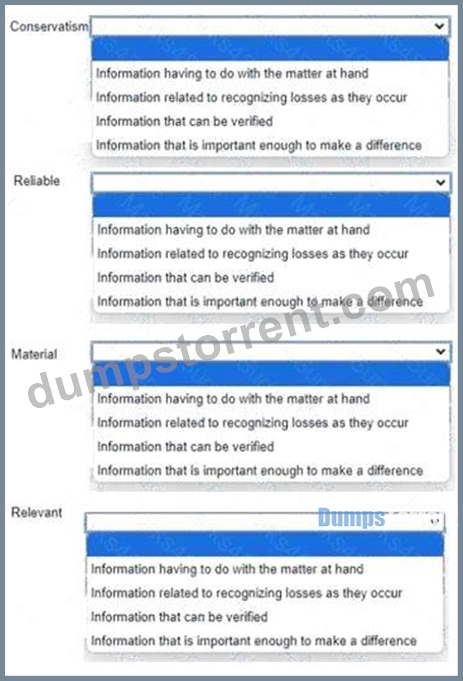
Answer:
Explanation: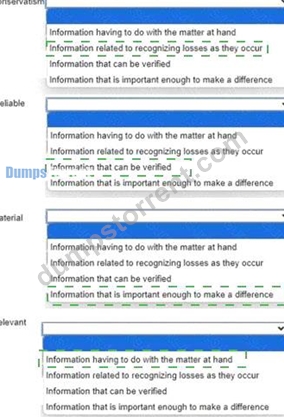
Explanation:
Conservatism - Information related to recognizing losses as they occur
Reliable - Information that can be verified
Material - Information that is important enough to make a difference
Relevant - Information having to do with the matter at hand
These accounting terms describe important qualitative ideas used in financial reporting. Conservatism means accountants should use caution when uncertainty exists, especially by recognizing potential losses sooner rather than delaying them. Reliable information is information that can be supported, confirmed, or verified, which makes it trustworthy for users of financial statements. Material information is significant enough to affect the decisions of investors, creditors, or other users. If leaving it out or misstating it could influence a decision, it is material. Relevant information is information that relates directly to the issue being considered and is useful for decision-making.
These concepts help ensure that accounting information is useful, dependable, and meaningful. Relevance focuses on usefulness, reliability focuses on trustworthiness, materiality focuses on significance, and conservatism focuses on caution under uncertainty. Together, they support better financial statement preparation and interpretation. In this matching question, each term lines up with its most standard accounting definition, so the correct matches are exactly as shown above.
NEW QUESTION # 28
What can be determined when a firm performs an external audit of a company's financial statements?
- A. Whether a company's financial statements were prepared by a trained bookkeeper
- B. Whether a company's financial statements indicate it made a profit
- C. Whether a company's financial statements fairly reflect its financial position
- D. Whether a company's financial statements indicate that the company has to pay income taxes
Answer: C
Explanation:
The correct answer is B. Whether a company's financial statements fairly reflect its financial position .
The purpose of an external audit is for the independent auditor to express an opinion on whether the financial statements present fairly, in all material respects , the company's financial position, results of operations, and cash flows in conformity with the applicable financial reporting framework. PCAOB auditing standards state this explicitly in the required auditor's report language.
Option A is incorrect because anyone reading the income statement can see whether the company reported a profit or loss; that alone is not the purpose of the audit. Option C is incorrect because tax liability is not what the audit opinion is primarily determining. Option D is also incorrect because an audit does not certify that the statements were prepared by a particular kind of employee such as a trained bookkeeper. Instead, the audit evaluates whether the statements are fairly presented and free of material misstatement. Therefore, the best answer is that an external audit helps determine whether the company's financial statements fairly reflect its financial position .
NEW QUESTION # 29
......
Updated Accounting-for-Decision-Makers Dumps Questions Are Available For Passing WGU Exam: https://braindumps2go.dumpstorrent.com/Accounting-for-Decision-Makers-exam-prep.html