

HPE0-V28 Exam Practice Questions prepared by HP Professionals
Use Valid New HPE0-V28 Questions - Top choice Help You Gain Success
HPE0-V28 exam is intended for IT professionals who have already earned the HPE ATP - Hybrid IT Solutions V2, HPE ATP - Data Center Solutions V1, or HPE ATP - Server Solutions V4 certification. HPE0-V28 exam measures the candidates' knowledge of HPE solutions, including HPE SimpliVity, HPE Nimble Storage, HPE Synergy, HPE ProLiant, and HPE OneView.
HP HPE0-V28 (Delta - HPE Edge-to-Cloud Solutions) Exam is designed to test the technical knowledge and skills of IT professionals who are involved in designing, implementing, and managing HPE edge-to-cloud solutions. Delta - HPE Edge-to-Cloud Solutions certification establishes the competency of the candidate in implementing HPE's end-to-end solutions architecture, starting from the HPE edge infrastructure to the hybrid cloud deployment with HPE Synergy and HPE OneView.
NEW QUESTION # 31
Match the Terms left to right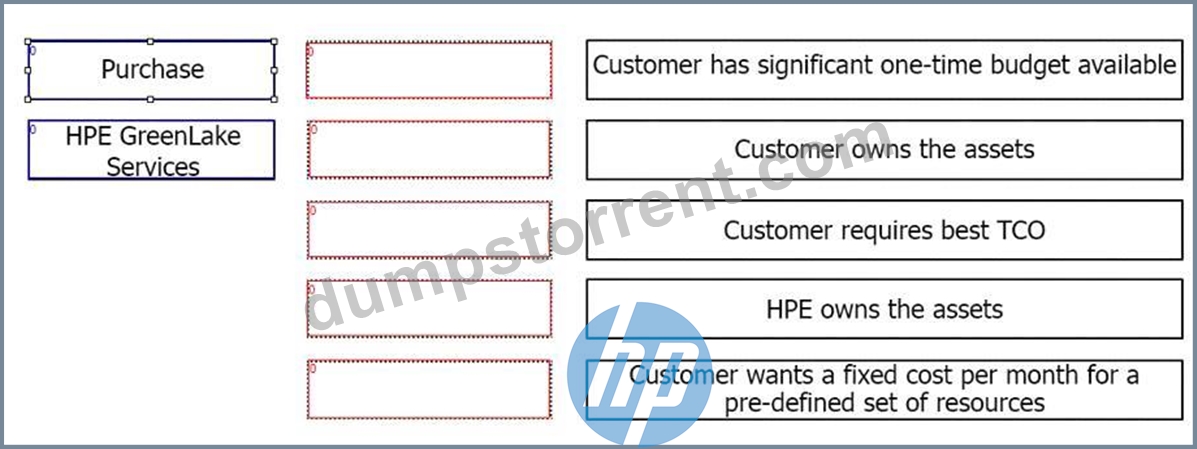
Answer:
Explanation: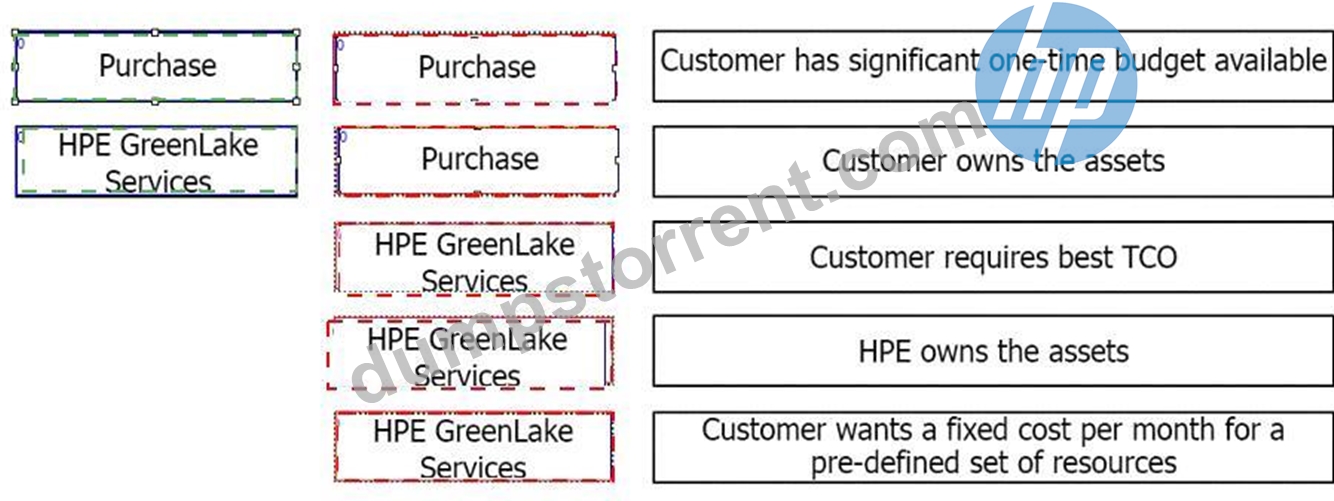
Explanation: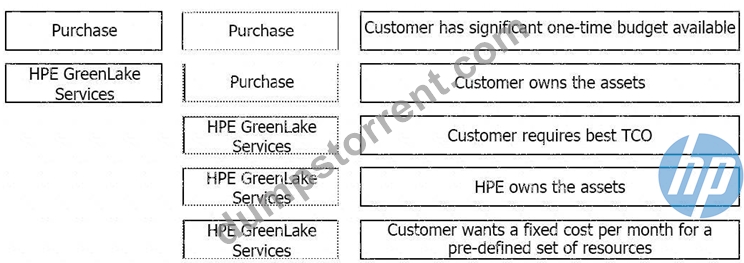
According to the HPE Edge-to-Cloud Solutions - Self-Directed Lab, page 14, the following terms match the statements:
Customer has significant one-time budget available = Purchase
Customer owns the assets = Purchase
Customer requires best TCO = HPE GreenLake Services
HPE owns the assets = HPE GreenLake Services
Customer wants a fixed cost per month for a pre-defined set of resources = HPE GreenLake Services Purchase: This is a traditional acquisition model where the customer pays upfront for the hardware, software, and services they need. The customer owns the assets and isresponsible for their maintenance, management, and upgrade. This model is suitable for customers who have a large one-time budget available and who want to have full control over their assets.
HPE GreenLake Services: This is a consumption-based model where the customer pays only for the resources they use, on a monthly basis. HPE owns the assets and provides them as a service to the customer, along with the necessary support, management, and optimization. This model is suitable for customers who want to reduce their capital expenditure, improve their TCO, and have a fixed cost per month for a pre-defined set of resources.
NEW QUESTION # 32
What is a good indication of a sales opportunity for an Aruba Mobile First Network?
- A. IT is struggling to keep up with the amount of data that the business is generating.
- B. The customer needs to streamline the onboarding process for personal devices.
- C. Clients are asking for services that the business does not currently offer.
- D. Developers need to accelerate their development cycles for mobile apps.
Answer: C
NEW QUESTION # 33
Which protocol should you recommend for a dedicated lossless fabric?
- A. Internet SCSI
- B. Fibre Channel over IP (FCIP)
- C. Fibre Channel (FCP)
- D. Fibre Channel over Ethernet (FCoE)
Answer: D
Explanation:
Fibre Channel over Ethernet (FCoE) is a protocol that allows Fibre Channel traffic to be encapsulated and transported over an Ethernet network. FCoE enables the convergence of storage and data networks, reducing the number of cables, switches, and adapters required for a dedicated lossless fabric. FCoE also preserves the features and benefits of Fibre Channel, such as high performance, reliability, security, and management. FCoE requires Enhanced Transmission Selection (ETS) and Priority-based Flow Control (PFC) to ensure lossless and low-latency transmission of storage traffic over Ethernet. HPE Aruba Ethernet-based storage fabrics support FCoE and provide cloud-like scalability and simplicity for data-driven applications1. References: Advanced HPE Edge-to-Cloud Solutions, Rev. 22.31 (0001196323) H61Z2S, HPE Aruba Ethernet-based storage fabrics bring cloud-like scalability to data-driven applications
NEW QUESTION # 34
Compared to OCA, which additional datacenter characteristic is required to configure a solution in SSET?
- A. Input phase
- B. KW per rack
- C. Country
- D. Input voltage
Answer: D
Explanation:
OCA (One Config Advanced) and SSET (Solution Sizer and Estimator Tool) are both tools that help design and configure HPE solutions. OCA is a web-based tool that allows users to create and validate configurations for HPE servers, storage, and networking products. SSET is a tool that helps users estimate the power, cooling, and space requirements for HPE solutions. SSET also provides recommendations for rack and power distribution units (PDUs). Compared to OCA, SSET requires an additional datacenter characteristic to configure a solution: the input voltage. This is because the input voltage affects the power consumption and efficiency of the solution. The input voltage can be either single-phase or three-phase, and it can vary depending on the country and region. SSET allows users to select the input voltage from a list of predefined values or enter a custom value. OCA does not require the input voltage as an input parameter, as it only focuses on the product configuration and compatibility. References: Edge to Cloud Solutions: Engineered Experiences to Unlock Your Full Potential, Chapter 5: Next Generation Compute, Storage, and Integrated Data Solutions, page 97. HPE SSET User Guide, page 7.
NEW QUESTION # 35
The need for greater agility is creating a need for a new role for IT. What is one way that IT's role is changing?
- A. IT needs to plan more extensively before making any changes.
- B. IT plays a supportive role in the background.
- C. IT now makes most purchasing decisions on its own.
- D. IT provides a competitive advantage for the company.
Answer: D
NEW QUESTION # 36
A customer tells you their company does not need services because the product warranty will provide sufficient protection. How can you explain why the warranty is not sufficient?
- A. The customer needs coverage outside normal business hours.
- B. The customer must prove that they did not cause the problem by misconfiguring the product.
- C. The customer is responsible for paying shipping costs for replacement parts.
- D. The customer needs replacement of defective parts.
Answer: A
NEW QUESTION # 37
When designing and architecting a solution based on customer requirements, which of the following is necessary?
- A. Documenting customer intent
- B. Planning the solution design
- C. Selecting the right HPE and 3rd party products and services
- D. Qualifying the customer requirements
Answer: D
NEW QUESTION # 38
Which of the following is necessary when architecting and designing an HPE solution based on customer needs?
- A. Documenting customer intent
- B. Planning the solution design
- C. Selecting the right HPE and 3rd party products and services
- D. Qualifying the customer requirements
Answer: D
NEW QUESTION # 39
Your customer wants to implement an environment for machine learning that requires low latencies and high transfer rates.
Which technology should you recommend to the customer?
- A. RoCE
- B. NFS
- C. SMB
- D. SCSI
Answer: A
Explanation:
The technology that should be recommended to the customer for machine learning that requires low latencies and high transfer rates is RoCE. RoCE stands for RDMA over Converged Ethernet, which is a protocol that enables Remote Direct Memory Access (RDMA) over Ethernet networks. RDMA is a technology that allows direct memory access from one computer to another without involving the operating system or the CPU, thus reducing the overhead and latency of data transfers. RoCE offers the following benefits for machine learning environments:
It supports high bandwidth and low latency data transfers, which are essential for machine learning applications that involve large amounts of data and complex computations12.
It improves the efficiency and scalability of the network, as it reduces the CPU utilization and the network congestion caused by data transfers13.
It leverages the existing Ethernet infrastructure, which is widely deployed and cost-effective, and does not require any specialized hardware or software14.
It is compatible with HPE solutions, such as HPE Alletra, HPE Synergy, and HPE Apollo, which support RoCE and provide optimized infrastructure and management services for machine learning workloads567.
The other options are not suitable for machine learning that requires low latencies and high transfer rates because:
A). SCSI stands for Small Computer System Interface, which is a set of standards for connecting and transferring data between devices, such as hard disks, tape drives, scanners, and printers. SCSI is mainly used for storage devices and does not support RDMA or Ethernet networks8.
C). SMB stands for Server Message Block, which is a network file sharing protocol that allows access to files, printers, and other resources on a network. SMB is mainly used for file sharing and does not support RDMA or Ethernet networks9.
D). NFS stands for Network File System, which is a distributed file system protocol that allows access to files over a network. NFS is mainly used for file sharing and does not support RDMA or Ethernet networks10.
References:
What is RoCE? | Mellanox Technologies
RoCE: The Key to Unlocking the Full Potential of AI - RoCE Initiative
RoCE: The Key to Unlocking the Full Potential of AI - RoCE Initiative
RoCE: The Key to Unlocking the Full Potential of AI - RoCE Initiative
HPE Alletra 6000 Data Sheet
HPE Synergy 480 Gen10 Compute Module - Overview
HPE Apollo 6500 Gen10 Plus System - Overview
What is SCSI (Small Computer System Interface)? - Definition from WhatIs.com What is SMB (Server Message Block)? - Definition from WhatIs.com What is NFS (Network File System)? - Definition from WhatIs.com
NEW QUESTION # 40
Match the tool to its use category.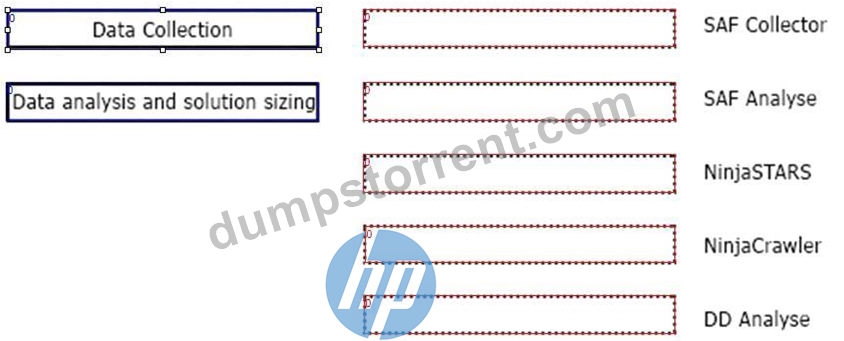
Answer:
Explanation: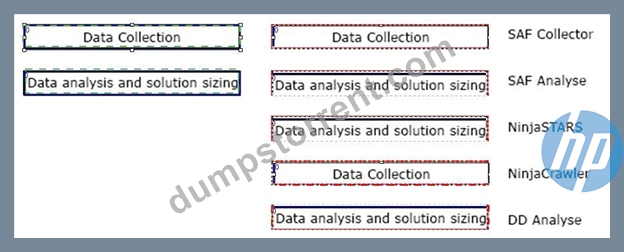
Explanation:
SAF Collector: This tool, judging by its name, seems to be used for collecting data. Therefore, it likely falls under the category ofData Collection.
SAF Analyse: Given its name, this tool is probably used for analyzing the data collected. This would place it in the category ofData analysis and solution sizing.
NinjaSTARS: This tool's exact function isn't clear from its name alone. However, tools with "STAR" in their name are often related to analysis or monitoring in IT contexts. Thus, it might fit into theData analysis and solution sizingcategory.
NinjaCrawler: The term "Crawler" typically refers to a tool that navigates and collects data from different sources, particularly in web and network contexts. Therefore, this tool is likely best suited for theData Collectioncategory.
DD Analyse: The "Analyse" part of this tool's name suggests that it is used for analyzing data, which would place it in theData analysis and solution sizingcategory.
https://www.hpe.com/us/en/hpe-edge-to-cloud-adoption-framework.html
NEW QUESTION # 41
How should you discuss digital transformation with your customers?
- A. Explain that digital transformation is just a buzzword and that they should focus on the New Economy instead.
- B. Downplay the importance of digital transformation, since it is a trend that is not as relevant as it was a year ago.
- C. Help them elevate digital transformation from an incubation project to a business imperative.
- D. Focus on the way public cloud solutions can speed delivery of services and applications.
Answer: D
NEW QUESTION # 42
Your customer required a managed private cloud solution of which they can retain ownership for tax purposes.
Which delivery model should you recommend?
- A. Custom HPE GreenLake solution based on a reference architecture.
- B. HPE Financial Services lease with GreenLake manaqement services.
- C. HPE GreenLake for Virtual Desktop Infrastructure (VDI).
- D. Traditional purchase with GreenLake manaqement services.
Answer: B
Explanation:
A managed private cloud solution is one where the customer has a dedicated cloud environment that is managed by a third-party provider. The customer can benefit from the scalability, flexibility, and security of the cloud, without having to deal with the infrastructure management and maintenance. However, the customer may also have specific requirements for ownership and tax purposes, such as retaining the title of the assets or depreciating them over time. In this case, a traditional purchase or a custom HPE GreenLake solution may not be suitable, as they would either require the customer to pay upfront for the infrastructure or transfer the ownership to HPE. HPE GreenLake for VDI is also not a good option, as it is a specific solution for virtual desktops, not a general-purpose cloud platform.
The best option for the customer is to use HPE Financial Services lease with GreenLake management services.
This option allows the customer to lease the infrastructure from HPE Financial Services, while HPE GreenLake provides the management and pay-per-use billing for the cloud services. The customer can retain the ownership of the assets at the end of the lease term, or renew the lease with updated technology. The customer can also take advantage of the tax benefits of leasing, such as deducting the lease payments as operating expenses or claiming depreciation allowances. This option provides the customer with a managed private cloud solution that meets their ownership and tax needs, while also offering the advantages of HPE GreenLake, such as cost savings, agility, and innovation. References: HPE GreenLake Cloud Services, HPE Financial Services, HPE GreenLake for Private Cloud Enterprise
NEW QUESTION # 43
Your customer needs a solution for a small VMWare cluster. They have limited staff and need a single solution that provides ease of management, scalability, and recovery capabilities.
What solution should you recommend?
- A. HPE SimpliVity
- B. HPE Nimble
- C. HPE MSA
- D. HPE Alletra
Answer: A
Explanation:
HPE SimpliVity is a hyperconverged infrastructure (HCI) solution that combines compute, storage, networking, and data protection in a single, scalable, and easy-to-manage appliance1.
HPE SimpliVity is optimized for VMware environments, as it integrates with VMware vSphere and vCenter, and supports VMware features such as vMotion, HA, DRS, and SRM2.
HPE SimpliVity simplifies the management of the VMWare cluster by providing a single interface to perform common tasks such as provisioning, cloning, backup, and restore of virtual machines2.
HPE SimpliVity also enables scalability and recovery capabilities by allowing customers to add nodes as needed, and leverage built-in data efficiency and resilience features such as deduplication, compression, and replication2.
HPE Nimble is a storage solution that provides high performance, availability, and data protection, but it does not include compute and networking components, and requires additional management tools for the VMWare cluster3.
HPE Alletra is a data infrastructure solution that delivers cloud-native data services, but it is designed for larger and more complex environments, and requires additional components such as HPE Data Services Cloud Console and HPE Cloud Volumes4.
HPE MSA is an entry-level storage solution that offers affordable and flexible options, but it does not provide the same level of data efficiency, resilience, and integration as HPE SimpliVity for the VMWare cluster.
The references are:
1: HPE SimpliVity 2: HPE SimpliVity for VMware vSphere 3: HPE Nimble Storage 4: HPE Alletra : [HPE MSA Storage]
NEW QUESTION # 44
What is the appropriate use case for a cloud solution?
- A. When legacy systems are still in use
- B. When there is a need for on-premises data storage
- C. When scalability and flexibility are not critical requirements
- D. When there is a need for high-speed network connectivity
Answer: D
NEW QUESTION # 45
Which steps is HPE taking to build their portfolio and accelerate their strategy? (Select two.)
- A. increasing marketing budgets for server, storage, and hyperconverged products
- B. decreasing the number of partnerships in order to focus on opportunities with top 10 industry leaders
- C. focusing on HPE Hybrid IT and de-emphasizing Mobile First Wireless solutions
- D. inventing new technologies for HPE Hybrid IT and HPE Intelligent Edge
- E. making strategic acquisitions that enable them to deliver complete solutions
Answer: D,E
NEW QUESTION # 46
Which of the following is a key activity when analyzing customer business and technical requirements for an HPE Edge-to-Cloud solution?
- A. Avoiding any customization to minimize complexity
- B. Documenting every possible requirement, regardless of its relevance to the solution
- C. Prioritizing requirements based on their potential impact on the solution outcomes
- D. Identifying the solution architecture before gathering requirements
Answer: C
NEW QUESTION # 47
What is one trend that is driving customers to implement Hadoop?
- A. the proliferation of unstructured data
- B. the development of SQL databases
- C. the shift toward systems of record
- D. the expansion of structured data
Answer: A
NEW QUESTION # 48
What is the correct method to calculate incremental cash flow?
- A. Substract projected increase in revenue or decrease in costs from the initial investment.
- B. Multiply the increase in revenue by the time needed to offset the IT investment.
- C. Divide the increase in revenue by the time needed to offset the IT investment.
- D. Substract projected decrease in revenue or increase in costs from the initial investment.
Answer: A
Explanation:
Incremental cash flow is the difference between the cash flow of a project with the investment and the cash flow of the same project without the investment. It represents the net change in cash flow that results from making the investment. The correct method to calculate incremental cash flow is to substract projected increase in revenue or decrease in costs from the initial investment. This method captures the additional cash inflows and outflows that are attributable to the investment, and excludes any cash flows that are unrelated to the investment. Incremental cash flow can help you evaluate the profitability and feasibility of an IT investment by comparing it to the required rate of return or the payback period. References: HPE Edge-to-Cloud Solutions - Self-Directed Lab, HPE Edge-to-Cloud Solutions - Official Certification Study Guide, Incremental Cash Flow Definition, How to Calculate Incremental Cash Flow
NEW QUESTION # 49
......
HPE0-V28 Exam Practice Materials Collection: https://braindumps2go.dumpstorrent.com/HPE0-V28-exam-prep.html