

[Nov-2025 Newly Released] ISO-9001-Lead-Auditor Exam Questions For You To Pass
PECB ISO-9001-Lead-Auditor Exam: Basic Questions With Answers
PECB ISO-9001-Lead-Auditor Exam Syllabus Topics:
| Topic | Details |
|---|---|
| Topic 1 |
|
| Topic 2 |
|
| Topic 3 |
|
NEW QUESTION # 25
In a third-party audit to ISO 9001, select two options of when the organisation is required to act in response to reported findings.
- A. A finding of conformity is reported.
- B. A major non-conformity is raised.
- C. A finding of good practice is reported.
- D. An opportunity for improvement is raised.
- E. A recommendation is given in the report.
- F. A minor non-conformity is raised.
Answer: B,F
Explanation:
According to ISO 19011:2018, clause 6.6.2, a nonconformity is the non-fulfilment of a requirement. A nonconformity can be classified as either major or minor, depending on the nature and extent of the deviation from the audit criteria. A major nonconformity is a nonconformity that affects the ability or the integrity of the organization's management system to achieve the intended results. A minor nonconformity is a nonconformity that does not affect the ability or the integrity of the organization's management system to achieve the intended results, but is a deviation from the audit criteria1.
According to ISO/IEC 17021-1:2015, clause 9.4.9, the organization is required to analyze the cause and describe the specific correction and corrective actions taken, or planned to be taken, to eliminate detected nonconformities, within a defined time. The organization is also required to provide the certification body with records and evidence of the implementation and effectiveness of the correction and corrective actions taken.
The certification body will then verify the correction and corrective actions taken by the organization and decide on the certification status2.
Therefore, the two options of when the organization is required to act in response to reported findings are D and F, as they indicate the presence of nonconformities that need to be corrected and prevented from recurring.
The other options are not correct, as they do not require the organization to act in response to reported findings:
*A. A recommendation is given in the report: A recommendation is a suggestion for improvement that is not related to a nonconformity. A recommendation is not binding for the organization and does not affect the certification status. The organization may choose to accept or reject the recommendation, but it is not required to act on it.
*B. A finding of good practice is reported: A finding of good practice is a positive observation that indicates a strength or a best practice of the organization's management system. A finding of good practice is not related to a nonconformity and does not affect the certification status. The organization may choose to acknowledge or share the finding of good practice, but it is not required to act on it.
*C. An opportunity for improvement is raised: An opportunity for improvement is a potential area where the organization's management system can be enhanced or optimized. An opportunity for improvement is not related to a nonconformity and does not affect the certification status. The organization may choose to pursue or ignore the opportunity for improvement, but it is not required to act on it.
*E. A finding of conformity is reported: A finding of conformity is a confirmation that the organization's management system fulfils the audit criteria. A finding of conformity is not related to a nonconformity and does not affect the certification status. The organization may choose to celebrate or communicate the finding of conformity, but it is not required to act on it.
References: ISO 19011:2018(en), Guidelines for auditing management systems, ISO/IEC 17021-1:2015(en), Conformity assessment - Requirements for bodies providing audit and certification of management systems
- Part 1: Requirements
NEW QUESTION # 26
Select the word that best completes the sentence:
Answer:
Explanation:
Explanation:
According to the ISO - Management system standards page, the key benefits of an effective management system include improved operational effectiveness and efficiency, improved risk management and protection of people and the environment, and enhanced drive for innovation. The Integrated Use of Management System Standards (IUMSS) handbook also states that the purpose and objectives of management system standards are to help organizations improve their performance by specifying repeatable steps that organizations consciously implement to achieve their goals and objectives.
Therefore, the complete sentence is:
"The purpose of a management system standard is to improve the performance of an organisation."
NEW QUESTION # 27
Technical experts must operate under the supervision of:
- A. An auditor
- B. The audit team leader only
- C. The auditee
Answer: A
Explanation:
Comprehensive and Detailed In-Depth Explanation:According to ISO 19011:2018, Clause 5.5 (Determining Audit Team Competence), technical experts:
* Provide specialized knowledge in an audit.
* Must operate under the supervision of an auditor to ensure compliance with audit protocols.
* Cannot work independently or under the auditee's supervision, as they are not responsible for the audit's findings.
The audit team leader has overall responsibility, but technical experts are supervised by an auditor during the audit process.
NEW QUESTION # 28
Select which one of the following statements is true.
- A. An audit team can include non-qualified auditors.
- B. A technical expert can replace a qualified auditor on an audit team.
- C. The team leader shall be an auditor that is qualified in the scheme.
- D. Audits leading to auditor qualification are undertaken annually.
Answer: C
Explanation:
According to the ISO 19011:2018 standard, which provides guidelines for auditing management systems, the team leader of an audit team should be an auditor who has demonstrated the competence to manage an audit of the relevant management system scheme. This means that the team leader should have the appropriate knowledge, skills, and experience to plan, conduct, report, and follow-up an audit of the specific management system, such as ISO 9001 for quality management systems. The other options are false because: B. An audit team can include non-qualified auditors, but only as observers or trainees who do not contribute to the audit findings or conclusions. C. A technical expert can assist a qualified auditor on an audit team, but cannot replace them, as a technical expert does not have the competence to perform audits. D. Audits leading to auditor qualification are not undertaken annually, but rather as part of a certification process that involves meeting certain criteria, such as education, work experience, audit experience, and examination. References:
ISO 19011:2018, PECB Certified ISO 9001 Lead Auditor Exam Preparation Guide, ISO 9001:2015 Quality Management Systems Lead Auditor Training Course
NEW QUESTION # 29
You will lead a third-party audit next Monday on ABC, an organisation that provides services for cleaning windows from the outside of tall buildings. They work on demand, and usually have 4-5 orders per week. All documented information on these activities is kept at the central office.
On Friday evening, before the audit, you are informed by mail that customers cancelled all orders for the next week; therefore, the auditors will not have the chance to see them working at the customer's premises, but the field supervisors will be available at the ABC offices.
You have prepared the audit plan and the checklist. Choose the best action you would take:
- A. Ask the Certification Body you work for how to proceed with the audit.
- B. Start the audit on Monday as planned, interviewing the functions that regularly work at the central office, and visit another customer's premises they cleaned the week before.
- C. Complete the audit but ask the quality manager to clean some windows at the ABC's office, simulating the process they carry out at customers' premises.
- D. Start the audit on Monday at ABC's as planned, interviewing the functions that regularly work at the central office, and plan visits to ABC customers wherever they may be working during the following week.
Answer: A
Explanation:
According to ISO 19011:2018, clause 6.3.3, the audit plan should be reviewed and revised as necessary to address changes that occur during the audit planning. The audit plan should be agreed upon, preferably in writing, by the audit team leader, the audit client and the auditee1. Therefore, if there is a significant change in the auditee's situation, such as the cancellation of all orders for the next week, the audit plan should be reviewed and revised accordingly, with the agreement of all parties involved.
According to ISO/IEC 17021-1:2015, clause 9.1.4, the certification body should have a process to ensure that the audit team has the competence to achieve the audit objectives, and that the audit methods are appropriate for the scope and complexity of the audit. The certification body should also have a process to ensure that the audit is conducted under reasonable conditions and within a reasonable time frame2. Therefore, if there is a risk that the audit objectives cannot be achieved, or that the audit methods are not suitable, due to the change in the auditee's situation, the certification body should be consulted and informed on how to proceed with the audit.
Therefore, the best action to take is B, ask the certification body you work for how to proceed with the audit.
This action will ensure that the audit plan is revised and agreed upon by all parties, and that the audit team has the competence and the methods to conduct the audit effectively and efficiently. The other options are not correct, as they may compromise the quality and validity of the audit:
*A. Start the audit on Monday at ABC's as planned, interviewing the functions that regularly work at the central office, and plan visits to ABC customers wherever they may be working during the following week:
This action may not be feasible or acceptable, as it may extend the audit duration and cost beyond the agreed terms, and it may not provide sufficient and appropriate audit evidence to verify the conformity and effectiveness of the auditee's processes. Moreover, this action may not be agreed upon by the audit client and the auditee, and it may not be approved by the certification body.
*C. Start the audit on Monday as planned, interviewing the functions that regularly work at the central office, and visit another customer's premises they cleaned the week before: This action may not be relevant or reliable, as it may not reflect the current performance and condition of the auditee's processes. The audit evidence collected from the previous customer may not be valid or representative of the audit criteria, and it may not address the risks and opportunities associated with the auditee's context and objectives. Moreover, this action may not be agreed upon by the audit client and the auditee, and it may not be approved by the certification body.
*D. Complete the audit but ask the quality manager to clean some windows at the ABC's office, simulating the process they carry out at customers' premises: This action may not be objective or impartial, as it may introduce bias and influence in the audit process. The audit evidence collected from the simulated process may not be accurate or authentic, and it may not demonstrate the actual capability and effectiveness of the auditee's processes. Moreover, this action may not be ethical or professional, as it may compromise the integrity and credibility of the audit and the certification.
References: ISO 19011:2018(en), Guidelines for auditing management systems, ISO/IEC 17021-1:2015(en), Conformity assessment - Requirements for bodies providing audit and certification of management systems
- Part 1: Requirements
NEW QUESTION # 30
You are leading a Stage 2 certification audit of a multi-site organisation and have received the audit schedule below; Head Office and Site 1 - Day 1 Site 2 (150 Km from HQ) - Days 2 and 3 During Day 1 of the audit, the dient informs you that the laboratory at Site 2 has been dosed for decontamination due to a serious outbreak of an infectious disease among workers. In Site 2, all other functions could be audited as planned.
As the audit team leader, what would you do?
Choose the best acceptable action you could take:
Ask the audit Programme Manager for direction.
Complete the audit on day 3 and report back to the certification body for a certification decision.
Continue the audit on days 2 and 3 and return later to audit the Site 2 laboratory.
Immediately cancel the audit since the audit plan cannot be completed.
Who has the responsibility for assigning work to the audit team?
- A. The auditee organisation
- B. The audit team member
- C. The audit team leader
- D. The certification body
Answer: C
Explanation:
In the context of ISO 9001:2015 audits, it is the audit team leader who holds the responsibility for assigning work to the audit team. According to ISO 19011:2018 (Guidelines for auditing management systems, which complements ISO 9001:2015), the audit team leader is responsible for the organization and direction of the audit, including assigning specific roles and responsibilities to audit team members. This includes preparation of the audit plan, leading the audit, and ensuring that each team member understands their tasks.
NEW QUESTION # 31
You work for an organisation, 'ABC', which provides packaged food to the public. You are asked to lead a team (you as the leader and two other auditors) to audit an external provider, 'XYZ', which provides packaging materials to your organisation. It is 4 pm, and the audit is dlose to an end; you are having an internal meeting with the team to decide what will be presented to the auditee during the Closing meeting. The Closing meeting was scheduled for 5 pm.
'XYZ' has two manufacturing lines: M1 is a clean room for primary packaging materials (i.e. will be in direct contact with the food), and M2 is for secondary materials (i.e. will not be in direct contact with food).
Auditor 1 audited the two manufacturing lines.
You: "What findings would you report?"
Auditor 1: "I have one issue. Earlier today in the morning I saw some secondary material stocked in the clean room. I would propose raising a nonconformity." You: "How would you write the nonconformity?" Auditor 1: "In the clean room, there was a pallet with secondary materials." What additional information would you add to this text to complete the nonconformity report? Select six.
- A. More information in the place within the clean room where secondary material was found
- B. Name of the forklift driver that was moving the pallet
- C. Description of any primary material close to this pallet
- D. Description of the secondary material
- E. Evidence that the secondary material was approved ready to be used
- F. The signature of the clean room's supervisor accepting the nonconformity
- G. Description of the ISO 9001:2015 requirement not being complied with and the clause number
- H. The type of nonconformity (major or minor)
- I. The date on which the evidence was identified
- J. Batch number of the secondary material
Answer: C,D,G,H,I,J
NEW QUESTION # 32
Scenario 4:
TD Advertising is a print management company based in Chicago. The company offers design services, digital printing, storage, and distribution. As TD expanded, its management recognized that success depended on adopting new technologies and improving quality.
To ensure customer satisfaction and quality improvement, the company decided to pursue ISO 9001 certification.
After implementing the QMS, TD hired a well-known certification body for an audit. Anne Key was appointed as the audit team leader. She received a document listing the audit team members, audit scope, criteria, duration, and audit engagement limits.
Anne reviewed the document and approved the audit mandate. The certification body and TD's top management signed the certification agreement.
Before contacting TD, Anne reviewed the audit scope and noticed that TD made changes to it due to the adoption of new printing equipment. However, Anne disagreed with the changes, stating they would affect the audit timeline. She considered withdrawing from the audit.
How do you assess the situation presented in the last paragraph of scenario 4?
- A. Anne has full authority to reject any scope changes, even if TD and the certification body agree.
- B. TD should have agreed with the certification body and Anne about any change in the audit scope.
- C. Anne cannot withdraw from the audit once the audit mandate is accepted.
- D. TD cannot make any change to the audit scope once it has been defined.
Answer: B
Explanation:
Comprehensive and Detailed In-Depth Explanation:
ISO 9001:2015 requires collaboration between the auditee (TD Advertising), the certification body, and the audit leader when making changes to audit scope.
Clause References:
* ISO/IEC 17021-1:2015, Clause 9.2.3 - Conducting the Audit: Any change in audit scope must be agreed upon by all parties before proceeding.
Why is the Correct Answer C?
* TD cannot unilaterally change the scope without agreement from the certification body and audit leader.
* The certification body must ensure the scope remains relevant and that resources are allocated properly.
Why are the Other Options Incorrect?
* A (Anne cannot withdraw) # Incorrect, Anne CAN withdraw if the changes make the audit unfeasible, but she must consult with the certification body first.
* B (TD cannot change the scope) # Incorrect, scope changes are allowed but must be formally approved.
* D (Anne has full authority to reject scope changes) # Incorrect, scope changes require mutual agreement among all parties.
NEW QUESTION # 33
What are the criteria for reviewing documented information?
- A. Content, format, and the procedure for managing documented information
- B. Language of documented information, internal audit reports, client feedback
- C. Archive, volume, and confidentiality of documented information
Answer: A
Explanation:
Comprehensive and Detailed In-Depth Explanation:According to ISO 9001:2015, Clause 7.5.2 (Creating and Updating Documented Information), the criteria for reviewing documented information include:
* Content - The accuracy and relevance of the information.
* Format - Ensuring readability and proper structuring (e.g., language, versioning).
* Procedure for managing documented information - Ensuring control, access, and updates.
Other options, such as internal audit reports and client feedback, are important for overall QMS evaluation but are not the main criteria for reviewing documented information.
NEW QUESTION # 34
A Health Trust has contracted with Servitup, a catering services organisation that has been certified to ISO
9001 for one year. It provides services to
10 small rural hospitals in remote locations involving the purchase and storage of dry goods and fresh produce, preparing meals, and loading heated trolleys for Ward Service by hospital staff. You, as auditor, are conducting the first surveillance audit at one site with the Deputy Catering Manager (DCM).
DCM: "I apologise for the absence of the Catering Manager. He has called in sick today and we are really short of staff." You: "I see. It really shouldn't affect the QMS so the audit can progress as normal." DCM: "The Catering Manager set up the system. I'm afraid I'm not as familiar with it as he is." You: "OK, let's start with the Quality Policy. What are the main issues for the QMS here?" DCM: "Give me a minute. I need to look at the Quality Policy on the noticeboard in his office." As the audit progresses, it is clear that the DCM has a very low knowledge of the QMS. He continually has to look up the answers to your questions or ask staff members about their processes. You decide to raise a nonconformity.
Select one of the following options that best describes the nonconformity.
- A. The Deputy Catering Manager is not competent to manage the QMS.
- B. The effectiveness of the QMS depends on the Catering Manager being present on site.
- C. As a member of the management team, the Deputy Catering Manager is not sufficiently aware of the QMS.
- D. The Quality Policy only exists as a document in the Catering Manager's office.
Answer: C
NEW QUESTION # 35
You are conducting an audit at a single-site organisation seeking certification to ISO 9001 for the first time.
The organisation manufactures cosmetics for major retailers and the name of the retailer supplied appears on the product packaging. Sales turnover has increased significantly over the past five years.
You are interviewing the new Product Development Manager. You note that a software application called SWIFT is used to help control the product development process.
You have gathered audit evidence as outlined in the table. Match the ISO 9001 clause 8.3 extracts to the audit evidence.
Answer:
Explanation:
A screenshot of a computer AI-generated content may be incorrect.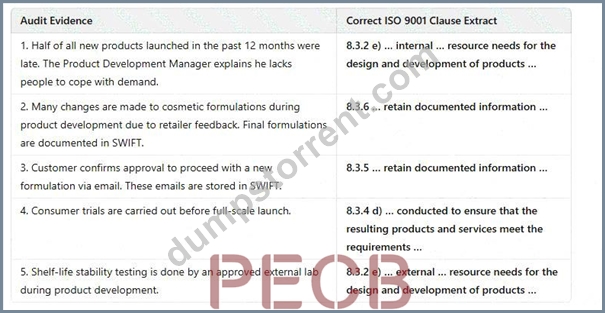
Comprehensive and Detailed In-Depth Explanation:
* Clause 8.3.2 e) - Internal Resource Needs:Delays due to staff shortages highlight a lack of internal resources, directly relating to this clause that requires internal resource planning for design and development.
* Clause 8.3.6 - Design and Development Changes:Ongoing formulation changes due to feedback need to be documented and reviewed. This clause requires retention of documented information on changes.
* Clause 8.3.5 - Design and Development Outputs:Customer approvals for formulations are outputs of the design process and must be retained as documented information, as per this clause.
* Clause 8.3.4 d) - Design and Development Controls:Consumer trials are a validation activity. This clause ensures such trials are conducted to confirm that resulting products meet defined requirements.
* Clause 8.3.2 e) - External Resource Needs:Shelf-life tests done by an external lab are part of the external resources needed for development and are referenced here.
NEW QUESTION # 36
You have been nominated audit team leader of a third-party audit. Which of the following could be the two most relevant objectives of this audit?
- A. Identify the need of resources
- B. Evaluate the capability of the management system to establish and achieve objectives
- C. Evaluate the effectiveness of the management system
- D. Identify opportunities for improvement
- E. Evaluate the satisfaction interested parties
- F. Evaluate the benefits obtained since the implementation of the management system
Answer: B,C
Explanation:
Evaluate the effectiveness of the management system: This objective involves verifying that the quality management system meets the requirements of a specific standard, such as ISO 9001:2015, and that it achieves the intended results and outcomes. The audit team will collect and analyse audit evidence to determine the degree of conformity and performance of the quality management system23.
*Evaluate the capability of the management system to establish and achieve objectives: This objective involves verifying that the quality management system supports the strategic direction and policies of the organization, and that it addresses the needs and expectations of the interested parties. The audit team will assess the suitability, adequacy, and alignment of the quality management system objectives, and the effectiveness of the planning and implementation processes to achieve them23.
The other options are not the most relevant objectives of a third-party audit, according to the web search results from my internal tool. They may be related to other aspects or types of audits, but they are not the focus of a third-party audit.
Therefore, the correct answer is B and D.
References: 1: Safeguarding Your Business: The Power of Third-Party Security Audits 2: ISO 19011:2018 - Guidelines for auditing management systems 3: Third Party Audit - QMSGurus.com
NEW QUESTION # 37
Scenario 1: AL-TAX is a company located in California which provides financial and accounting services. The company manages the finances of 17 companies and now is seeking to expand their business even more The CEO of AL-TAX, Liam Durham, claims that the company seeks to provide top- notch services to their clients Recently, there were a number of new companies interested in the services provided by AL-TAX.
In order to fulfill the requirements of new clients and further improve quality, Liam discussed with other top management members the idea of implementing a quality management system (QMS) based on ISO 9001. During the discussion, one of the members of the top management claimed that the size of the company was not large enough to implement a QMS. In addition, another member claimed that a QMS is not applicable for the industry in which AL TAX operates. However, as the majority of the members voted for implementing the QMS. Liam initiated the project.
Initially, Liam hired an experienced consultant to help AL-TAX with the implementation of the QMS.
They started by planning and developing processes and methods for the establishment of a QMS based on ISO 9001. Furthermore, they ensured that the quality policy is appropriate to the purpose and context of AL TAX and communicated to all employees. In addition, they also tried to follow a process that enables the company to ensure that its processes are adequately resourced and managed, and that improvement opportunities are determined.
During the implementation process, Liam and the consultant focused on determining the factors that could hinder their processes from achieving the planned results and implemented some preventive actions in order to avoid potential nonconformities Six months after the implementation of the QMS.
AL-TAX conducted an internal audit. The results of the internal audit revealed that the QMS was not fulfilling all requirements of ISO 9001. A serious issue was that the QMS was not fulfilling the requirements of clause 5.1.2 Customer focus and had also not ensured clear and open communication channels with suppliers.
Throughout the next three years, the company worked on improving its QMS through the PDCA cycle in the respective areas. To assess the effectiveness of the intended actions while causing minimal disruptions, they tested changes that need to be made on a smaller scale. After taking necessary actions, AL-TAX decided to apply for certification against ISO 9001.
Based on the scenario above, answer the following question:
Scenario 1 indicates that AL-TAX did not ensure clear and open communication channels with interested parties. Which quality management principle did the organization not follow in this case?
- A. Relationship management
- B. Leadership
- C. Evidence-based decision making
Answer: A
Explanation:
Comprehensive and Detailed In-Depth Explanation:
ISO 9001:2015 is based on seven quality management principles, one of which is Relationship Management. This principle emphasizes the importance of maintaining open communication and collaboration with interested parties, including suppliers and customers.
Clause 7.4 (Communication) requires organizations to determine what, when, with whom, and how communication should take place. Since AL-TAX failed to ensure clear communication channels, it did not adhere to this principle. Effective relationship management helps improve supply chain performance, customer satisfaction, and overall QMS effectiveness.
Reference:
ISO 9001:2015, Clause 7.4 - Communication
ISO 9001:2015, Quality Management Principles - Relationship Management
NEW QUESTION # 38
"A set of interrelated or interlacing elements of an organization to establish policies and objectives, and processes to achieve those objectives" is the definition of a/an:
- A. Organization scope
- B. Standard
- C. Quality manual
- D. Management system
Answer: D
Explanation:
Comprehensive and Detailed In-Depth Explanation:According to ISO 9000:2015, which provides definitions for terms used in ISO 9001:2015, a management system is defined as a set of interrelated or interacting elements of an organization to establish policies, objectives, and processes to achieve those objectives.
A Quality Management System (QMS) is a type of management system that ensures organizations meet customer and regulatory requirements while improving performance.
Clause 3.5.3 of ISO 9000:2015 clearly defines "management system" and aligns with this question. The other options do not fit the definition:
* Standard refers to an established norm or requirement.
* Organization scope defines the boundaries of a QMS but is not a system itself.
* Quality manual is a document (optional under ISO 9001:2015) that describes a QMS but is not the system itself.
NEW QUESTION # 39
You are a member of the audit team of a second-party audit of an organisation with 625 employees. The audit procedure recommends using sampling criteria which requires the review of the documented competence for
25 personnel. The audit team leader developed an audit plan allocating one hour to audit the Human Resources department (from 11:30 am to 12:30 pm). She told you that she could not allocate any additional time.
What would you do?
- A. Plan to review as many as possible and see if you can extend the audit duration by one day.
- B. Plan to miss lunch and review as many as possible.
- C. Plan to review less than 25 cases.
- D. Extend the audit until 1.00pm and ask for a quick lunch later.
Answer: C
Explanation:
In this scenario, the time allocated by the audit team leader for the Human Resources audit is fixed, and as an auditor, you must work within that constraint. Although the sampling criteria suggests reviewing 25 personnel files, it is acceptable to adjust the sample size based on time and resource limitations. ISO 9001:2015 emphasizes risk-based thinking and practical resource management (Clause 7.1), so it is reasonable to review a smaller sample if the time is insufficient.
Option B is a pragmatic approach, allowing you to focus on quality over quantity by reviewing as many cases as time allows without compromising the audit schedule.
Options like extending the audit (A, C, D) are impractical in a structured audit environment, especially for second-party audits where maintaining the agreed schedule is important.
NEW QUESTION # 40
Below are four of the seven principles on which ISO 9000 series are based. Match a potential benefit to each of the quality management principles (QMP).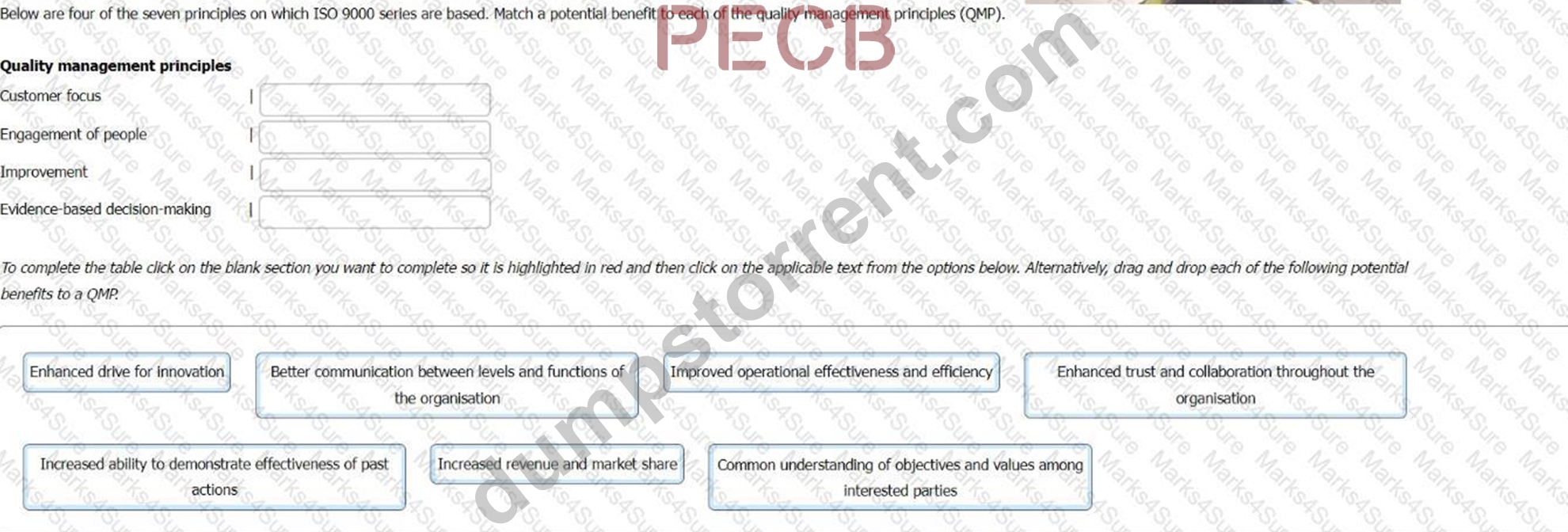
Answer:
Explanation: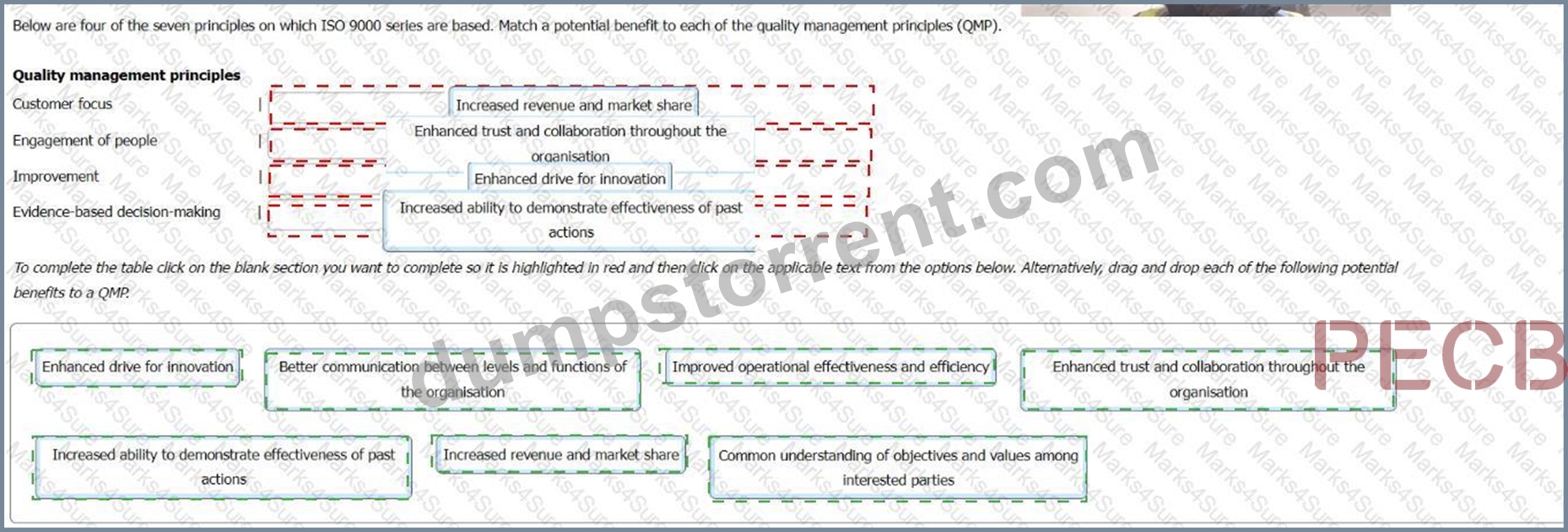
Explanation:
A screenshot of a chat Description automatically generated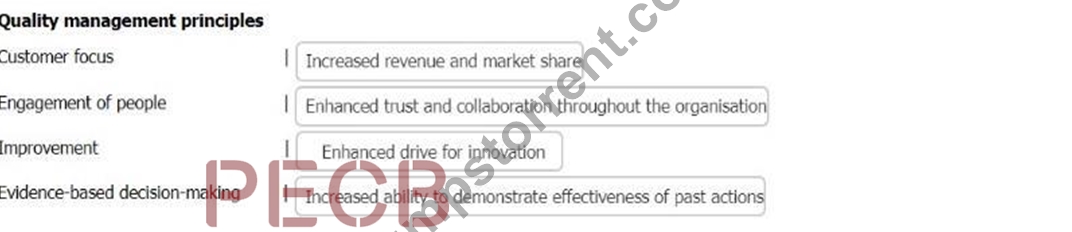
According to the ISO 9000:2015 document, the seven quality management principles are:
Customer focus
Leadership
Engagement of people
Process approach
Improvement
Evidence-based decision making
Relationship management
For each principle, the document provides a statement, a rationale, key benefits, and actions you can take to apply the principle in your organization.
Based on the document, here is a possible way to match a potential benefit to each of the four quality management principles you mentioned:
Table
Quality management principle
Potential benefit
Customer focus
Increased revenue and market share
Engagement of people
Enhanced trust and collaboration throughout the organization
Improvement
Enhanced drive for innovation
Evidence-based decision making
Increased ability to demonstrate effectiveness of past actions
NEW QUESTION # 41
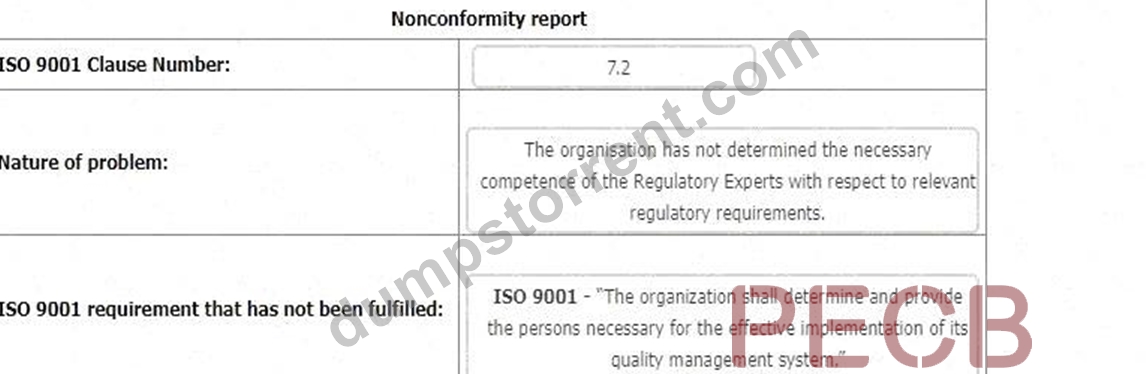
You are carrying out an audit to ISO 9001 at an organisation which offers regulatory consultancy services to manufacturers of cosmetics.
You are interviewing the Technical Director (TD), who manages a team of regulatory experts responsible for providing regulatory services to customers.
You: "How do you ensure your regulatory team's competence concerning regulatory requirements is maintained?" TD: "The two Regulatory Experts we employ full-time have years of experience of working in the cosmetics industry." You: "How is their regulatory competence maintained?" TD: "They are dedicated individuals with lots of contacts in the sector." You: "How does the business enable them to maintain their understanding of current regulatory requirements?" TD: "We leave that up to them."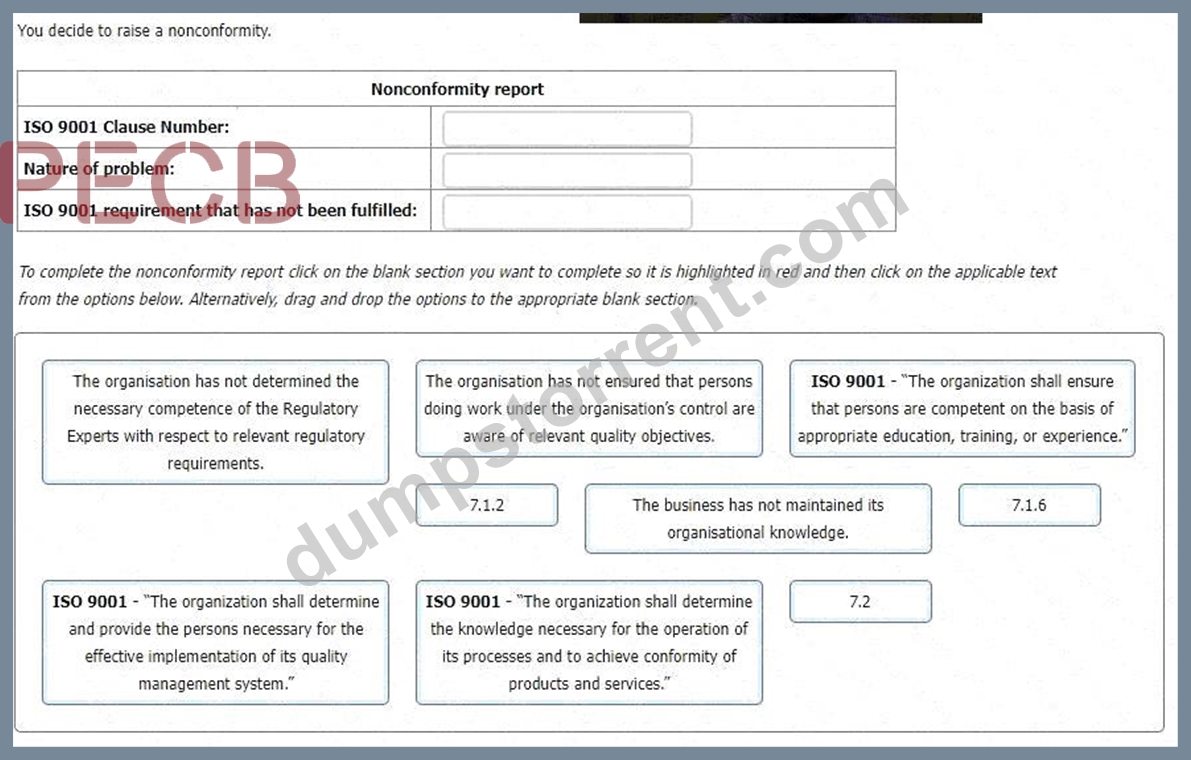
Answer:
Explanation: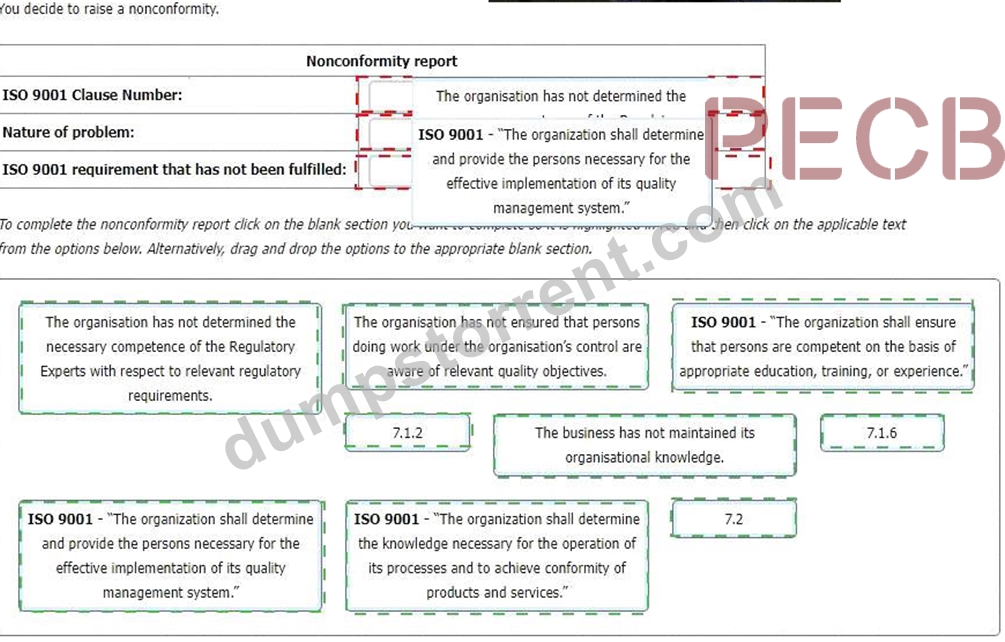
NEW QUESTION # 42
Scenario 2:
Bell is a Canadian food manufacturing company that operates globally. Their main products include nuts, dried fruits, and confections. Bell has always prioritized product quality and has maintained a good reputation for many years. However, the company's production error rate increased significantly, leading to more customer complaints.
To increase efficiency and customer satisfaction, Bell implemented a Quality Management System (QMS) based on ISO 9001. The top management established a QMS implementation team comprising five middle managers from various departments, including Leslie, the quality manager.
Leslie was responsible for assigning responsibilities and authorities for QMS-related roles. He also suggested including a top management representative in the QMS team, but top management declined due to other priorities.
The team defined the QMS scope as:
"The scope of the QMS includes all activities related to food processing." Leslie established a quality policy and presented it to the team for review before top management approval
. Top management also proposed a new strategy for handling customer complaints, requiring biweekly customer surveys to monitor customer perceptions.
Which situation presented in scenario 2 is NOT compliant with ISO 9001?
- A. The responsibilities and authorities for QMS roles were assigned by Leslie, the quality manager.
- B. The QMS implementation team did not include a representative from top management.
- C. The QMS implementation team comprised five middle managers.
- D. The quality policy was reviewed by the implementation team before top management approval.
Answer: B
Explanation:
Comprehensive and Detailed In-Depth Explanation:
ISO 9001:2015 Clause 5.1.1 (Leadership and Commitment) states that top management must demonstrate leadership and commitment to the QMS by actively participating in QMS implementation, integration, and effectiveness.
In scenario 2, top management refused to be directly involved in the QMS implementation team, which violates Clause 5.1.1 because leadership involvement is essential for the system's success.
Other options do not indicate nonconformance:
* Option A (Middle managers in the QMS team) is acceptable.
* Option C (Leslie assigning roles) is valid if competence is ensured (Clause 5.3 - Organizational Roles, Responsibilities, and Authorities).
* Option D (Team reviewing the policy before approval) aligns with best practices.
Reference:
ISO 9001:2015, Clause 5.1.1 - Leadership and Commitment
ISO 9001:2015, Clause 5.3 - Organizational Roles, Responsibilities, and Authorities
NEW QUESTION # 43
What is a list of actions that should be performed during the audit with their respective timeline?
- A. The audit objectives.
- B. The audit criteria.
- C. The audit offer.
- D. The audit schedule.
Answer: D
Explanation:
Comprehensive and Detailed In-Depth Explanation:
The audit schedule provides a structured timeline of activities to be conducted during the audit.
Clause References:
* ISO 19011:2018, Clause 6.4.2 - Preparing the Audit Plan:
* Requires the development of an audit schedule, including the sequence and timing of activities
.
* ISO/IEC 17021-1:2015, Clause 9.1.3 - Audit Program:
* Certification bodies must establish a schedule for conducting audits.
Why is the Correct Answer C?
* The audit schedule ensures systematic execution of the audit by defining activities, responsible auditors, and timeframes.
* A well-planned schedule improves efficiency and helps auditors cover all necessary areas within the given time.
Why are the Other Options Incorrect?
* A (Audit objectives) # Define why the audit is conducted, not the schedule.
* B (Audit criteria) # Define the standards and requirements to be evaluated, not the timeline.
* D (Audit offer) # Refers to the initial proposal sent to the auditee, not the activity timeline.
NEW QUESTION # 44
Whistiekleen is a national dry cleaning and laundry organisation with 50 shops. You are conducting a surveillance audit of the Head Office and are sampling customer complaints. You find that 80% of complaints originate from five shops in the same region. Most of these complaints relate to damage to customer laundry.
The Quality Manager tells you that these are the oldest shops in the organisation. The deaning equipment needs replacing but the organisation cannot afford it now. You learn that the shop managers were told to dismiss most of the claims based on the poor quality of the laundered materials.
On raising the matter with senior management, you are told that there are plans to replace the equipment in these shops over the next five years.
Match the ISO 9001 Clauses to the statements.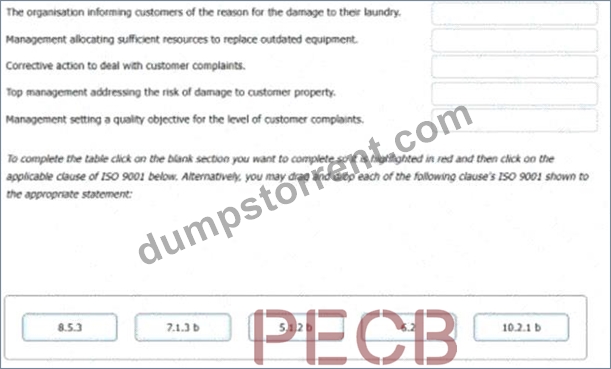
Answer:
Explanation: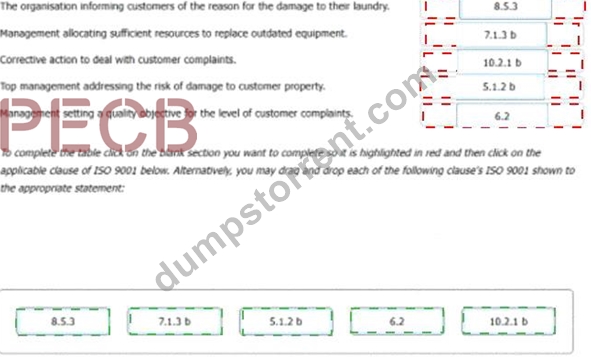
Explanation:
A screenshot of a computer AI-generated content may be incorrect.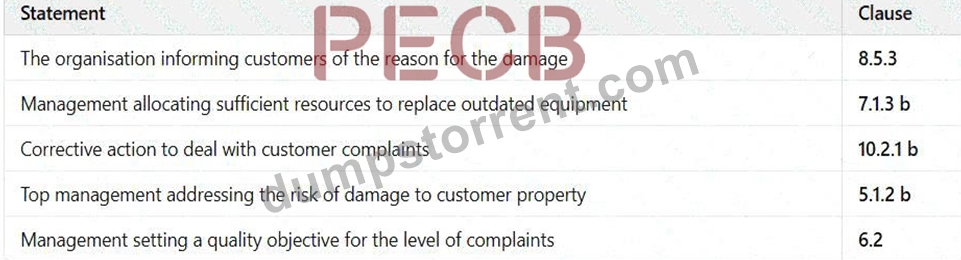
* Clause 8.5.3 - Property Belonging to Customers or External Providers:This clause requires the organization to care for customer property while it is under their control. If there is damage, they must inform the customer and retain documented information. Thus, informing customers of the reason for laundry damage relates directly to this clause.# Reference: ISO 9001:2015 Clause 8.5.3
* Clause 7.1.3 b - Infrastructure:It refers to the provision and maintenance of infrastructure necessary for the operation of processes. This includes equipment. If resources are not allocated for outdated equipment, it directly breaches this clause.# Reference: ISO 9001:2015 Clause 7.1.3 b
* Clause 10.2.1 b - Corrective Action:This clause covers actions to eliminate the causes of nonconformities to prevent recurrence, including evaluating and correcting customer complaints.# Reference: ISO 9001:2015 Clause 10.2.1 b
* Clause 5.1.2 b - Customer Focus (Top Management):Top management must ensure risks to customer satisfaction, including property damage, are addressed. This aligns with addressing the risk of damaging customer laundry.# Reference: ISO 9001:2015 Clause 5.1.2 b
* Clause 6.2 - Quality Objectives and Planning to Achieve Them:Setting objectives for reducing customer complaints (like those about laundry damage) falls under this clause.# Reference: ISO 9001:
2015 Clause 6.2
NEW QUESTION # 45
An internal auditor of a manufacturer of polystyrene packaging products for the electronics industry raised a nonconformity against section 10.3 of ISO 9001 in Report IA202. The nonconformity (NC 3) stated:
"The reject rate of 'finished' product of 9.7% needs improvement as it doesn't meet the stated objective of top management of 5%." Just before the Closing meeting of a third-party audit, the audit team leader is invited to a meeting with the Quality Manager. He tells the audit team leader that a member of the audit team was seen taking photographs of the factory on his phone during the day and wants him suspended from the Closing meeting with any nonconformities raised by him rescinded. The issue of photographs was not discussed during the opening meeting.
Select the three options for how the audit team leader might deal with this situation.
- A. Apologise for the situation and ensure the Quality Manager that all photographs will be deleted during the Closing meeting
- B. Advise the Quality Manager that the auditor will be reported to Head Office
- C. Advise the Quality Manager that he, as audit team leader, needs to speak to the auditor about the situation and he will report back to the Quality Manager once this is done
- D. State that the auditor will take no further part in the audit and all his photographs will be deleted
- E. Insist that the nonconformities must stand since they have been agreed by the team from other evidence gathered
- F. Delay the Closing meeting until the audit team leader has consulted his audit programme manager at Head Office
Answer: C,E,F
Explanation:
* This option reflects a balanced and professional approach. The audit team leader should first gather information directly from the involved auditor to understand the situation before making any decisions.
It demonstrates due diligence and fairness.
* This ensures that the situation is properly escalated and handled in accordance with the auditing body's procedures. Consulting the audit programme manager helps ensure consistency in handling such incidents.
* The nonconformity raised is based on objective evidence, independent of the incident with the photographs. ISO 9001 audits are evidence-based, and the validity of the findings should not be compromised by unrelated issues.
1. A. Advise the Quality Manager that he, as audit team leader, needs to speak to the auditor about the situation and he will report back to the Quality Manager once this is done:2. D. Delay the Closing meeting until the audit team leader has consulted his audit programme manager at Head Office:3. E. Insist that the nonconformities must stand since they have been agreed by the team from other evidence gathered:
* B. Advise the Quality Manager that the auditor will be reported to Head Office:
* Reporting the auditor directly without first investigating the situation is premature and unprofessional. It might escalate the issue unnecessarily.
* C. Apologize for the situation and ensure the Quality Manager that all photographs will be deleted during the Closing meeting:
* Deleting evidence without proper consultation could be seen as tampering or unprofessional conduct. It's essential to understand the context of the photographs first.
* F. State that the auditor will take no further part in the audit and all his photographs will be deleted:
* This is an extreme response without first investigating the situation. Taking unilateral action without gathering facts can damage the audit's integrity.
Why Not the Other Options:
NEW QUESTION # 46
Who assigns a guide to assist the audit team?
- A. The audit team leader
- B. The auditee
- C. The certification body
Answer: B
Explanation:
Comprehensive and Detailed In-Depth Explanation:
According to ISO 19011:2018, Clause 6.4.3 (Roles and Responsibilities of Guides and Observers):
* The auditee assigns a guide to assist the audit team.
* The guide provides logistical support, helps with navigation, and arranges access to necessary personnel and records.
* The audit team leader does not assign the guide, but they may request one.
Reference:
ISO 19011:2018, Clause 6.4.3 (Roles and Responsibilities of Guides and Observers)
NEW QUESTION # 47
......
New 2025 Realistic Free PECB ISO-9001-Lead-Auditor Exam Dump Questions and Answer: https://braindumps2go.dumpstorrent.com/ISO-9001-Lead-Auditor-exam-prep.html